Article 2 : Corridor to the Future: High-Speed Rail, Freight and Rare Earth Connectivity
Why in News: In the Union Budget 2026, the Finance Minister announced seven high-speed rail corridors, a new freight corridor, and rare earth corridors to act as growth connectors and boost industrial and mineral development.
Key Details
- Seven high-speed rail corridors will connect major economic cities as “growth connectors”.
- A new East–West Dedicated Freight Corridor from Dankuni (WB) to Surat (Gujarat) was announced.
- Rare earth corridors will be developed in mineral-rich states like Odisha, Kerala, Andhra Pradesh, and Tamil Nadu.
- The initiatives aim to promote sustainable transport, logistics efficiency, mining, and manufacturing.
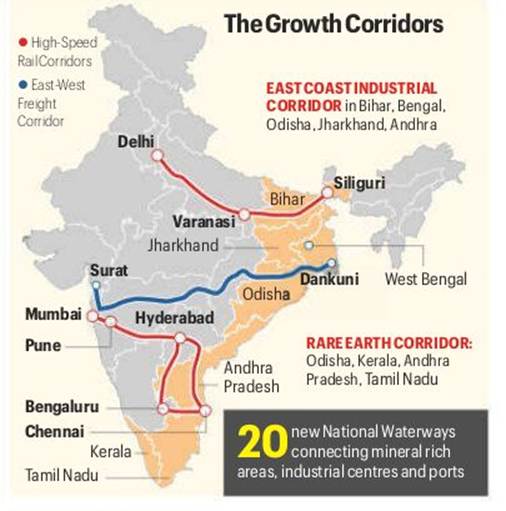
High-Speed Rail Corridors as Growth Connectors
- Concept of High-Speed Rail (HSR): High-speed rail refers to passenger trains operating at speeds above 250 km/h, significantly reducing travel time and enhancing regional integration, as seen in Japan and China.
- Proposed Corridors: The seven corridors include Mumbai–Pune, Pune–Hyderabad, Hyderabad–Bengaluru, Hyderabad–Chennai, Chennai–Bengaluru, Delhi–Varanasi, and Varanasi–Siliguri, covering key economic and population centres.
- Economic Multiplier Effect: HSR corridors stimulate urbanisation, real estate, tourism, and service-sector growth, transforming connected cities into integrated economic clusters.
- Learning from Mumbai–Ahmedabad Bullet Train: India’s first HSR project, scheduled for full completion by 2029, provides technological and institutional experience for scaling future corridors.
Dedicated Freight Corridors and Logistics Efficiency
- Need for Freight Corridors: India’s logistics cost is around 13–14% of GDP, higher than global benchmarks, making freight efficiency a key economic priority.
- Dankuni–Surat East–West Corridor: The proposed corridor will connect eastern industrial regions with western ports, improving freight movement across mineral, manufacturing, and export hubs.
- Decongestion of Passenger Lines: Dedicated freight corridors allow separation of freight and passenger traffic, improving speed, safety, and punctuality on existing rail networks.
- Integration with Multimodal Logistics: Freight corridors complement initiatives like PM Gati Shakti and National Logistics Policy, enabling seamless road–rail–port connectivity.
Rare Earth Corridors and Strategic Mineral Security
- Importance of Rare Earth Minerals: Rare earth elements are critical for electronics, electric vehicles, renewable energy, defence systems, and semiconductors.
- India’s Mineral Potential: States like Odisha, Kerala, Andhra Pradesh, and Tamil Nadu have significant rare earth and mineral reserves but remain underutilised.
- Value Chain Development: The proposed corridors aim to promote mining, processing, research, and manufacturing, reducing dependence on imports, especially from China.
- Strategic and Geopolitical Relevance: Strengthening domestic rare earth capacity enhances India’s strategic autonomy and aligns with the Make in India and Atmanirbhar Bharat initiatives.
Role of Waterways and Multimodal Connectivity
- Expansion of National Waterways: The announcement of 20 new national waterways will connect mineral-rich regions with industrial centres and ports.
- Cost-Effective and Sustainable Transport: Inland waterways are cheaper and more energy-efficient compared to road and rail, supporting low-carbon logistics.
- Boost to Coastal and Inland Trade: Improved waterways enhance cargo movement for bulk goods like coal, minerals, and cement, supporting industrial growth.
- Synergy with Rail and Road Corridors: Multimodal integration strengthens last-mile connectivity and reduces overall logistics bottlenecks.
Sustainable and Balanced Regional Development
- Environment-Friendly Transport: High-speed rail and waterways reduce carbon emissions compared to road transport, aligning with India’s climate commitments.
- Balanced Regional Growth: Corridors passing through eastern and southern India help address regional disparities by linking lagging regions with growth centres.
- Employment Generation: Infrastructure projects create large-scale employment during construction and through long-term industrial expansion.
- Urban Planning and Smart Growth: Corridor-based development encourages planned urbanisation, reducing pressure on mega cities.
Conclusion
The proposed high-speed rail, freight, and rare earth corridors mark a strategic shift towards integrated, sustainable, and future-ready infrastructure. Successful implementation will require coordinated planning, land acquisition reforms, private sector participation, and environmental safeguards. If executed effectively, these corridors can transform India’s connectivity landscape and support its ambition of becoming a $5 trillion economy.