Article 3: TB Elimination Strategy
Why in News: India has intensified its tuberculosis elimination efforts through a 100-day campaign featuring AI-based screening and nutrition support after missing the 2025 target.
Key Details
- Government launched a 100-day intensified TB elimination campaign targeting high-risk populations.
- Use of AI-enabled handheld X-ray devices for early detection, including asymptomatic cases.
- Focus on 1.58 lakh high-risk villages/wards and vulnerable groups such as slum dwellers, prisoners, and patients with comorbidities.
- Introduction of ₹1000 nutrition support within 15 days to reduce early mortality.
Tuberculosis Burden in India
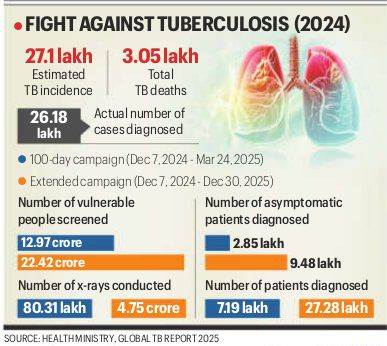
- High Disease Burden: India accounts for the largest share of global TB cases, with around 27.1 lakh estimated cases (2024), making it a major public health concern.
- Mortality and Detection Gap: Approximately 3.05 lakh deaths annually indicate gaps in early diagnosis and treatment adherence despite 26.18 lakh reported cases.
- Socio-economic Linkages: TB is closely associated with poverty, malnutrition, overcrowding, and poor sanitation, making it both a medical and developmental issue.
- Vulnerable Populations: High-risk groups include HIV patients, diabetics, smokers, migrant workers, and slum dwellers, highlighting the need for targeted interventions.
Government Strategy: 100-Day TB Elimination Campaign
- Targeted Screening Approach: The campaign focuses on 1.58 lakh high-risk areas, identified using parameters like TB incidence, malnutrition, and population density.
- Mass Screening Drive: Screening of over 22 crore vulnerable individuals is planned, aiming to detect hidden and asymptomatic TB cases.
- Focus on Early Detection: Early diagnosis is prioritised as most TB deaths occur within the first two months of infection.
- Integration with Existing Programmes: The campaign builds on the National TB Elimination Programme (NTEP), strengthening last-mile delivery.
Role of Technology: AI in Public Health
- AI-enabled X-ray Devices: Around 2,000 handheld AI-powered X-ray machines are deployed to detect TB within seconds, even before symptoms appear.
- Detection of Asymptomatic Cases: AI tools identified nearly 9.48 lakh asymptomatic TB cases, improving early intervention and reducing transmission.
- Efficiency and Accessibility: Portable devices enable screening in remote areas, slums, and mobile camps, bridging healthcare access gaps.
- Digital Health Integration: Use of SMS reminders and digital tracking ensures better treatment adherence and monitoring.
Nutritional and Social Support Measures
- Direct Benefit Transfer (DBT): Provision of ₹1000 nutritional support within 15 days addresses malnutrition, a key factor in TB mortality.
- Holistic Patient Care: Focus on personalised care, including follow-ups, counselling, and adherence support.
- Addressing Malnutrition-TB Nexus: Malnutrition weakens immunity, increasing TB risk; hence, nutrition support is critical for recovery.
- Link with Welfare Schemes: Integration with schemes like food security and health insurance enhances treatment outcomes.
Challenges in TB Elimination
- Missed 2025 Target: India’s goal to eliminate TB by 2025 (ahead of global SDG target 2030) remains unmet due to structural constraints.
- Underreporting and Stigma: Social stigma and lack of awareness lead to delayed diagnosis and hidden cases.
- Drug Resistance: Rising cases of Multi-Drug Resistant TB (MDR-TB) complicate treatment and increase costs.
- Health System Gaps: Issues like limited infrastructure, workforce shortages, and uneven healthcare access hinder progress.
Global and Policy Context
- SDG Target 3.3: Aims to end TB epidemic by 2030, requiring accelerated national efforts.
- WHO End TB Strategy: Focuses on early detection, universal drug access, and social protection measures.
- India’s Leadership Role: India’s progress is crucial globally, as it contributes significantly to global TB burden.
- Jan Andolan Approach: Government promotes TB elimination as a people’s movement, involving communities and civil society.
Conclusion
India’s renewed push through technology, targeted screening, and nutritional support reflects a multi-dimensional strategy to combat tuberculosis. However, achieving elimination requires strengthening primary healthcare, reducing stigma, ensuring treatment adherence, and addressing socio-economic determinants. A combination of policy commitment, technological innovation, and community participation is essential to transform TB elimination into a successful public health mission.
EXPECTED QUESTIONS FOR UPSC CSE
Prelims MCQ
Q. Consider the following regarding Tuberculosis in India:
- It is caused by a bacterial infection.
- Malnutrition is a risk factor.
- AI-based tools are being used for early detection.
Which of the statements is/are correct?
- 1 only
- 1 and 2 only
- 1 and 3 only
- 1, 2 and 3
Answer: d
Descriptive Question
Q. Examine the role of targeted public health interventions in controlling communicable diseases in India with reference to tuberculosis. (150 Words, 10 Marks)