Editorial 1 : Why aircraft are most likely to meet with accidents during takeoffs, landings
Context
An Air India Boeing 787 Dreamliner flying from Ahmedabad to London Gatwick with 242 people on board crashed shortly after takeoff recently.
What the data say
- Data has shown that most crashes take place during landing, takeoff, or the phases immediately before/after these two events.
- According to data from the trade group International Air Transport Association (IATA), the landing phase accounted for more than half (53%) of all aviation accidents from 2005 to 2023.
- The takeoff phase was the next most deadly, accounting for 8.5% of all accidents.
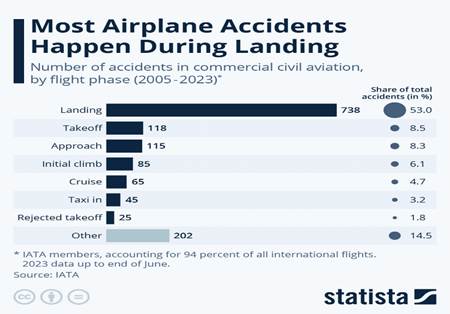
- The phases immediately before/after these two events — the approach phase before landing and the initial climb phase after takeoff — contributed to another 8.5% and 6.1% of accidents, respectively. Rejected takeoffs accounted for 1.8% of accidents.
- The takeoff and the initial climb phases accounted for 20% of all such accidents as well as 20% of all fatalities despite accounting for only 2% of exposure.
- The subsequent climb phase accounted for another 10% of fatal accidents and, notably, 35% of fatalities, despite accounting for only 14% of exposure.
- On the other hand, the final approach and landing phases accounted for 47% of all accidents and 37% of fatalities, despite making up 4% of exposure. The descent phase accounted for another 3% of accidents and 7% of fatalities.
Why takeoffs and landing are deadliest
- An aircraft is at the highest risk of meeting an accident at the beginning and end of the flight.
- The most basic explanation for this is that during these phases, aircraft are what in aviation lingo is called “low and slow”, leaving pilots very little time to react if something goes wrong.
- When cruising at 36,000 feet, a pilot has the luxury of time and space to course correct. Even if both engines go out, the plane won’t just fall out of the sky. It becomes a glider.
- In this state, a typical airliner loses about a mile in altitude for every 10 it moves forward, giving the pilot a little over eight minutes to find a place to land. But if something goes wrong on the ground, that window shrinks considerably.
- A multitude of environmental and situational factors put stresses on the aircraft during the takeoff and landing phases, meaning that the probability of something going wrong is also higher at this time.
- In simpler words, if during takeoff, the pilot takes an excessive nose up attitude, the aircraft can simply fall out of the air.
- Aircraft engines are also under the maximum stress during takeoff, especially the moment when the hundreds of tonnes heavy vehicle has to fight the forces of gravity to lift off from the ground. This too increases the possibility of failures.
- On the other hand, the pilot herself is most stressed during landings. This is because this is the most technically challenging aspect of flying, requiring the pilot to consider a host of variables, from wind speed and direction to how heavy the aircraft is, while making constant decisions regarding attitude and speed.
- Most aviation accidents, more so during the landing phase, occur due to pilot error.
- Lastly, aircraft are also more likely to encounter bird strikes, turbulence, and unavoidable inclement weather at low altitudes, increasing the likelihood of accidents
Still safest mode of travel
- Nonetheless, it is much safer to travel by airplane than by any other mode of transport. And data show that aviation has become progressively safer over the years.
- According to data from the UN body International Civil Aviation Organisation (ICAO), accidents per million departures in commercial flights went down from 4.9 in 2005 to 1.9 in 2023.
- Similarly, air crash fatalities have shown a general downward trend, although this statistic is more prone to year-on-year fluctuation.
- Aircraft today are better built, more reliable and well-equipped to deal with contingencies, pilots are better trained because of modern simulators, and significant improvements have been made in weather prediction and gathering various analytical data.
Way forward
Aviation safety protocols too have been refined over time to be where they are today. In short, more people are flying than ever before, but fewer aircraft are crashing than before and still fewer fatal accidents are taking place.