Editorial 2 : Why Northeast-Kolkata link via Myanmar — not Bangladesh — is significant
Context
Amid a downturn in India’s relationship with Bangladesh, the long-delayed Kaladan Multi Modal Transit Transport Project (KMMTTP) linking Mizoram to Kolkata via Myanmar has grown in importance.
The Kaladan Project
- After feasibility studies were conducted in the late 1990s and early 2000s, the KMMTTP framework was signed by India and Myanmar in 2008.
- This was set to be a major development in India’s strategically vital Look East Policy.
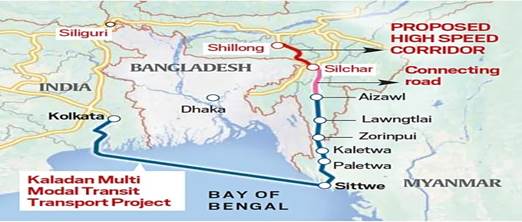
- The idea behind the project was straightforward. To create a transit corridor from the port of Sittwe in the Rakhine State in Myanmar to Mizoram, and eventually the rest of Northeast India.
- This would allow goods to be shipped from India’s eastern ports — primarily Kolkata — to Sittwe and then taken to Mizoram and beyond.
- Upon completion, the KMMTTP would effectively shave off 1,000 km in distance between Kolkata and Mizoram, and save a journey time of three-to-four days.
A multimodal project
- As the term “multi-modal” suggests, the project combines several modes of transport.
- Kolkata to Sittwe: This 539 km stretch between the two seaports will be covered by ship via the Bay of Bengal. This part of the project has been completed.
- Sittwe to Paletwa: This 158 km stretch on the Kaladan river in Myanmar will be covered by boat. The river is navigable and all work has been completed on this part of the project.
- Paletwa to Zorinpui: This 108 km four-lane road will be the last leg of the corridor in Myanmar. Myanmar has granted all approvals for this part of the project, and the Integrated Customs & Immigration Checkpost at Zochawchhuah-Zorinpui has been operational since 2017
- Zorinpui to Aizwal & beyond: While Zorinpui is connected to Aizwal and the rest of the Northeast by road, the NHIDCL plans to eventually extend the high-speed corridor from Shillong all the way to the border town.
Behind long delay
- Although work on the KMMTTP began a decade and a half ago, the political situation in the Rakhine State has precluded the corridor from becoming operational. The project was set to be completed in 2016.
- Myanmar is among the most ethnically diverse countries in the world, while the Bamar/Burman make up more than 65% of the population, there are well over 100 ethnic minorities spread across the country.
- Since 1948, when it received independence from British rule, Myanmar’s many ethnic minorities have been in armed conflict with the Bamar-dominated state.
- This conflict once again picked up after a military coup in 2021 ousted the nominally civilian government that had been in place in Yangon for a decade.
- A study published in December 2024 estimated that the Tatmadaw (Myanmar’s military) controls only 21% of territory, with the rest divided among a dozen or so warring ethnic militias.
- Much of the Rakhine State through which the KMMTTP passes is currently under control of the Arakan Army, now rebranded with the more-inclusive moniker Rakhine Army.
Way forward
- To get the corridor operational, New Delhi will thus have to deal with an ethnic militia which Yangon has officially designated as a terrorist outfit.
- Possible way will be engaging in quiet diplomacy with both the Myanmar government and regional stakeholders, leveraging backchannel negotiations to ensure security along the corridor.
- Simultaneously, India may consider working with ASEAN partners and multilateral forums to facilitate humanitarian dialogue and regional stability, without directly legitimizing militant groups.