Balanced, Surplus, and Deficit Budget MCQs with Explanations
Government budgets are classified into balanced, surplus and deficit budgets depending on the relationship between government income and expenditure. This topic explains their advantages, disadvantages and impact on inflation, employment and economic growth. Practice these MCQs to strengthen your preparation for competitive examinations.
Consider the following budget deficits of Central Government :
Primary deficit
Fiscal deficit
Revenue deficit
The correct descending order of their values is :
Code :
Correct Answer:
(A) 2, 3, 1
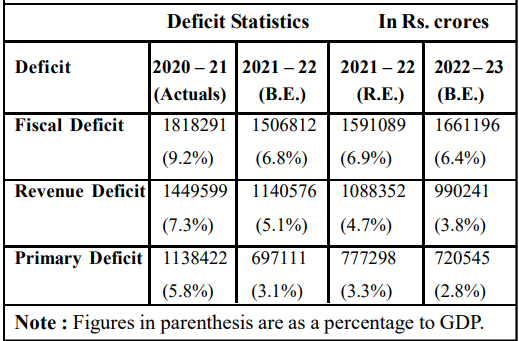
The correct descending order of the values of given deficits is as follows :
Fiscal deficit > Revenue deficit > Primary deficit
The recent trends of deficits in the Union Budget are presented in the following table :
Fiscal deficit is the largest, encompassing both revenue and capital expenditure.
Revenue deficit is a part of the fiscal deficit, representing only the shortfall in revenue-based spending.
Primary deficit is the smallest, as it excludes interest payments from the fiscal deficit.
Deficit Type
Actuals 2022-23
Budgeted 2023-24
Actuals 2023-24
Budgeted 2024-25
% change (2023-24 Actuals to 2024-25 BE)
Revenue Deficit
10,69,926
8,69,855
7,65,624
5,80,201
-24.2%
% of GDP
3.9%
2.9%
2.6%
1.8%
Fiscal Deficit
17,37,755
17,86,816
16,53,670
16,13,312
-2.4%
% of GDP
6.4%
5.9%
5.6%
4.9%
Primary Deficit
8,09,238
7,06,845
5,89,799
4,50,372
-23.6%
% of GDP
3.0%
2.3%
2.0%
1.4%
Ques: 2
Match List I with List II and select the correct answer using the codes given below the lists :
List I (Term) List II (Explanation)
A. Fiscal deficit 1. Excess of Total Expenditure over Total Receipts
B. Budget deficit 2. Excess of Revenue Expenditure over Revenue Receipts
C. Revenue deficit 3. Excess of Total Expenditure over Total Receipts less borrowings
D. Primary deficit 4. Excess of Total Expenditure over Total Receipts less borrowings and Interest Payments
Codes :
A B C D
Correct Answer:
(A) 3 1 2 4
The excess of Government's total expenditure (both revenue and capital) over total receipts (both revenue and capital) constitutes budget deficit. From the 1997-98 Budget, the practice of showing budget deficit has been discontinued in India. The excess of Government's revenue expenditure over revenue receipts constitutes revenue deficit. The difference between the total expenditure of Government by way of revenue, capital and loans net of repayments on the one hand and revenue receipts of Government and capital receipts which are not in the nature of borrowing but which accrue to Government on the other, constitutes gross fiscal deficit. Gross primary deficit is gross fiscal deficit reduced by the gross interest payments. Note : In the Budget documents 'gross fiscal deficit' and 'gross primary deficit' have been referred to in abbreviated form 'fiscal deficit' and 'primary deficit', respectively.
In short,
Budget deficit = Total expenditure – Total receipts
Revenue deficit = Revenue expenditure – Revenue receipts
Fiscal deficit = Total expenditure – Total income / revenue (Revenue receipts + Non-debt creating capital receipt)
= Total expenditure – [Total receipts less borrowings (debt and other liabilities)]
= Budget deficit + Internal and external borrowings
Primary deficit = Fiscal deficit – Interest payments
Ques: 3
If interest payments are subtracted from gross fiscal deficit, the remainder will be :
Correct Answer:
(A) Gross primary deficit
The borrowing requirement of the government includes interest obligations on accumulated debt. The goal of measuring primary deficit is to focus on present fiscal imbalances. To obtain an estimate of borrowing on account of current expenditures exceeding revenues, we need to determine what has been called the primary deficit.
Primary deficit = Fiscal deficit – Interest payments or,
Primary deficit = Fiscal deficit – Net interest liabilities
Net interest liabilities consist of interest payments minus interest receipts by the government on net domestic lending.
Ques: 4
After deducting grants for the creation of capital assets from revenue deficit, we arrive at :
Correct Answer:
(D)
Effective Revenue Deficit
Effective revenue deficit is defined as the difference between revenue deficit and grants for creation of capital assets. Effective revenue deficit signifies that amount of capital receipts that are being used for actual consumption expenditure of the Government. The concept of effective revenue deficit has been initiated from Union Budget for the financial year 2011-12. The main objective to introduce this type of deficit concept is to denote constructive imbalances of revenue account. It included in the Fiscal Responsibility and Budget Management Act, 2003 through an amendment in 2012. In Budget Estimates 2023-24 the effective Revenue deficit is revised estimated at 1.8 percent of GDP whereas in estimates of 2024-25 it was at 0.8 percent of GDP.
Ques: 5
There has been a persistent deficit budget year after year. Which action/actions of the following can be taken by the Government to reduce the deficit?
Reducing revenue expenditure
Introducing new welfare schemes
Rationalizing subsidies
Reducing import duties
Select the correct answer using the code given below :
Correct Answer:
(C) 1 and 3 only
Ques: 6
'Budget' is an instrument of-
Correct Answer:
(C) fiscal policy of the government
Budget is an instrument of fiscal policy of the government. Under Article 112 of the Constitution, a statement of the estimated receipts and expenditure of the Government of India has to be laid before both the Houses of Parliament in respect of every financial year. This statement titled 'Annual Financial Statement' is the main Budget document.