The correct sequence of these assets in the decreasing order of liquidity is-
Correct Answer:
(D) 4-1-3-2
Currency is the most liquid asset because it is easiest for transactions. Time deposit is least liquid because it is fixed for a definite period of time and it cannot be used before its maturity. Demand deposits are more liquid than saving deposits because they can be demanded by the holder from the bank at any time. Hence option (d) is the correct answer.
Ques: 2
What is black money?
Correct Answer:
(D) It is an illegal income upon which income tax is not paid
Black money includes all funds earned through illegal activity and otherwise legal income that is not recorded for tax purposes. Black money proceeds are usually received in cash from underground economic activity and, as such, are not taxed. It is a big threat for the development of a country’s economy. The government had taken many steps to bring out illegal money from time to time, such as – Voluntary Disclosure of Income Scheme.
Ques: 3
Which one of the following effects of creation of black money in India has been the main cause of worry to the Government of India?
Correct Answer:
(D) Loss of revenue to the State Exchequer due to tax evasion
There is no uniform definition of black money in the literature or economic theory. In fact, several terms with similar connotations have been in vogue, including 'unaccounted income', 'black income', 'dirty money', 'black wealth', 'underground wealth', 'black economy', 'parallel economy', 'shadow economy', and 'irregular' or 'unofficial' economy. All these terms usually refer to any income on which the taxes im- posed by the government or public authorities have not been paid. According to the 2019 a report of Standing Committee on Finance, the sectors that see the highest incidence of black money include real estate, mining, pharmaceuticals, pan masala, the gutkha and tobacco industry bullion and commodity markets, the film industry, educational institutions and professionals. Loss of revenue to the State Exchequer due to tax evasion is a big problem for the Indian economy which has been highlighted multiple times by the Economic Surveys. Black money (tax evasion) reduces the fiscal resources of the government for running the welfare schemes. Hence, the most appropriate answer is option (d).
Ques: 4
Due to inflation :
Prices of goods increase
Correct Answer:
(D)
Inflation refers to the rise in the prices of goods and services and decline of purchasing power of a given currency over time. In comparison to foreign currencies, the value of Indian rupee also declines due to inflation. Hence, it does not improve the exchange rate.
Ques: 5
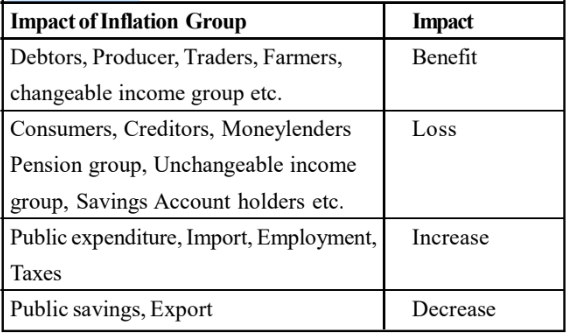
Who amongst the following benefits most from inflation :
Correct Answer:
(B) Debtors
Due to inflation, the prices of goods and services increase and the purchasing power of currency decline over time. In this situation, debtors get advantage and creditors get disadvantage.
Ques: 6
Which of the following is likely to be the most inflationary in its effects?
Correct Answer:
(D) Creation of new money to finance a budget deficit
Deficit financing means generating funds to finance the deficit which results from excess of expenditure over revenue. The gap being covered by borrowing from the public by the sale of bonds or by printing new money.Government expenditure by printing money boosts incomes and raises private demand in the economy. Thus, it fuels inflation. A little increase in inflation is healthy as it encourages business activity. But if the government doesn’t stop in time, more and more money floods the market and creates high inflation. And since inflation is revealed with a lag, it is often too late before governments realise, they have over-borrowed. Higher inflation and higher government debt provide grounds for macroeconomic instability.
Ques: 7
Which one of the following statements is an appropriate description of deflation?
Correct Answer:
(C) It is a persistent fall in the general price level of goods and services.
Inflation denotes rise in general price level in an economy. Deflation is just opposite of inflation which denotes fall in general price level of goods and services in an economy.
Ques: 8
Given below are two statements one is labelled as Assertion (A) and other as Reason (R) :
Assertion (A) : The government faces a tough time tackling the bottleneck inflation.
Reason (R) : The situation is due to deficiencies existing in the economy such as supply bottleneck and inefficient distribution.
Select the correct answer from the codes given below.
Codes :
(A) and (R) are true and (R) is correct explanation of
(A)
Correct Answer:
(A) and (R) are true, but (R) is not correct explanation of
Bottleneck inflation is the inflation that takes place when supply falls drastically while demand remains at the same level. This creates excess demand in the economy as the supply cannot match it and thus results in rising of prices. Such situations arise due to supply-side accidents, hazards, mismanagement or inefficient distribution. The government faces a tough time in this situation of inflation. Hence, both Assertion and Reason are true and Reason is the correct explanation of Assertion.
Ques: 9
Core inflation is defined as :
Correct Answer:
(D) Headline inflation excluding both food inflation and fuel inflation.
Core inflation represents the long run trend in the price level and in measuring long run inflation, transitory price changes should be excluded. Thus, core inflation is an inflation measure which excludes transitory or temporary price volatility as in the case of some commodities such as food items, fuel products etc. Hence, core inflation is defined as headline inflation excluding both food inflation and fuel inflation.
Ques: 10
Tick mark which is incorrect about inflation :
Correct Answer:
(C) For some commodities retail price are also considered for measurement of inflation.
In India, Consumer Price Index (CPI)and Wholesale Price Index (WPI) are two major indices for measuring inflation. The WPI was main index of inflation in India till April 2014, when Reserve Bank of India (RBI) adopted new CPI (Combined) as the key measure of inflation. It is noteworthy that WPI is based on wholesale prices for primary articles, administered prices for fuel items and ex-factory prices for manufactured products, while CPI is based on retail prices and it measures change over time in general level of prices of goods and services that households acquire for the purpose of consumption.