An examination of tidal phenomena caused by the gravitational interplay between the Earth, Moon, and Sun. It differentiates between Spring and Neap tides, analyzing amphidromic systems and tidal bores in shallow estuaries.
What are the causes of high-tide low tide formation in the oceans ?
Correct Answer:
(D)
Due to Gravitation, Centripetal force and the centrifugal force
High tide/low tide occurs as a result of the force of gravitational pull between the Earth and the Moon and the two forces viz centripetal force and centrifugal force produced upon the Earth. Ocean water is kept at equal levels around the planet by the Earth's gravity pulling inward, but Moon's gravitational force is strong enough to disrupt this balance by accelerating the water in that hemisphere which faces the Moon. When the Moon's force of attraction is stronger than the centrifugal force of the Earth, high tides occur. On the other hand, when the centrifugal force is stronger than the Moon's force of attraction tides (Indirect high tide) occur. Earth experiences high and low tides twice in 24 hours.
Ques: 2
Given below are two statements, one is labelled as Assertion (A) and the other as Reason (R).
Assertion (A) : During the times of neap-tide, high-tide is below normal and low-tide is above normal.
Reason (R) : Neap-tides occurs during the new moon instead of full-Moon.
Choose the correct answer using following options –
(A) and (R) both are correct, and (R) is correct explanation of
(A).
Correct Answer:
(C) is correct, but (R) is wrong.
During the neap-tides, high-tide remains to be 20% less than the normal and low-tide at this time remains to be higher than the normal. Neap-tide is opposite to the spring-tide and it doesn't occur at New-moon or full-moon but on 7th or 8th days from these two extremes. Therefore, assertion (A) is correct but the reason (R) is wrong.
Ques: 3
In which one of the following positions given in the figure sea-tide would have maximum height ?
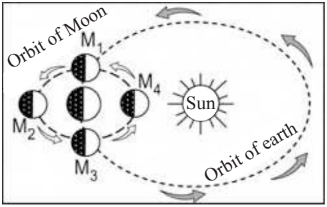
Correct Answer:
(D)
M4
In the figure, M2 is the position of Full Moon and M4 is the position of New Moon. In both of these positions the Sun, the Moon and the Earth remains in linear position and this situation is known as 'Syzygy'. In both of these situations, spring tides occur. During New Moon's (closest perigee or proxigee) proxigeam spring tides occur.
Ques: 4
The high tide in the Ocean is caused by
Correct Answer:
(D)
Moon
Spring-tide occurs in the ocean on the day of Full Moon, while at 7th and 8th day after the Full Moon or the New Moon neap-tide occurs. Since, the Moon is more near to the Earth in comparison to other stars, so its gravitational force has a greater effect upon the Earth. Due to this effect, high sea waves are produced in oceans. Tide producing power of the moon is 2.17 times more than the Sun.
Ques: 5
What is a diurnal tide cycle?
Correct Answer:
(D)
A tide cycle that occurs once a day
Tides are commonly semi-diurnal (two high waters and two low waters each day), or diurnal (one tidal cycle per day). The two high waters on a given day are typically not the same height (the daily inequality); these are the higher high water and the lower high water in tide tables.
Ques: 6
What do we call a high tide that occurs on the opposite side of the Earth from the Moon?
Correct Answer:
(B) Antipodal
High tides on the antipodal position occur because other parts of the Earth receive stronger gravitational acceleration exerted by the Moon, compared to the specific location.
Ques: 7
What do we call the flow of water as the tide rises or falls?
Correct Answer:
(B) Tidal current
Tides create a current in the oceans, near the shore, and in bays and estuaries along the coast. These are called "tidal currents." Tidal currents are the only type of currents that change in a very regular pattern and can be predicted for future dates.
Ques: 8
What is the tidal range?
Correct Answer:
(A) The difference in sea level between the low tide and high tide
Tidal range is the difference in height between high tide and low tide. Tides are the rise and fall of sea levels caused by gravitational forces exerted by the Moon and Sun, by Earth's rotation and by centrifugal force caused by Earth's progression around the Earth-Moon barycenter.
Ques: 9
What tidal current occurs exactly at high tide or low tide?
Correct Answer:
(D)
Slack water
Slack water occurs twice during a tidal cycle. In coastal waters (flow influenced by friction and boundaries), one slack water occurs closer to low water (low-water slack tide, LWS) and another slack water occurs closer to high water (high-water slack tide, HWS)