This section analyzes the closest planet to the Sun. It addresses its high density, lack of a substantial atmosphere, orbital resonance, extreme diurnal thermal ranges, and major scientific flyby discoveries.
The Planet Mercury is revolving around the Sun in an elliptical orbit, as shown in the given figure. The Kinetic energy of Mercury is greatest at the point labelled.
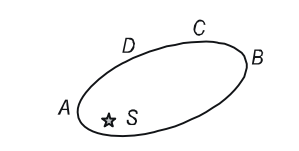
Correct Answer:
(A) A
The closer a planet is to the sun, the stronger the sun's gravitational pull on it. Thus, the planet moves faster.
Ques: 2
Which of the following planet takes the least time to orbit the sun:
Correct Answer:
(B) Mercury
The planet Mercury takes the least time to complete one rotation around the sun. The time taken by all eight planets to complete one rotation around the Sun is as follows – Mercury - 87.96 Days
Venus - 224.68 Days
Earth - 365.26 Days
Mars - 686.98 Days
Jupiter - 11.862 Years
Saturn - 29.456 Years
Uranus - 84.07 Years
Neptune - 164.81 Years
Ques: 3
Consider the following statement:
The albedo of an object determines its visual brightness when viewed with reflected light.
The albedo of Mercury is much greater than the albedo of the Earth.
Which of the statements given above is/are correct?
Correct Answer:
(A) 1 only
The term albedo is commonly used to determine the brightness of the planet. Planet Mercury receives greater sunlight in comparison to Earth but its albedo is less than that of Earth. The Albedo of Mercury is 0.138 while of Earth, it is 0.367. Thus, only statement (1) is true and option (a) is correct.
Ques: 4
The smallest planet of the solar system is:
Correct Answer:
(A) A. Mercury
Mercury is the smallest planet in our solar system. It's also the closest planet to the Sun. Mercury is slightly larger than the moon.
Ques: 5
Which of the following pairs of planets is without satellites?
Correct Answer:
(B) b) Mercury and Venus
Mercury and Venus are the only planets in our solar system without any natural satellites or moons. All other planets have at least one moon orbiting them. Earth has one moon (the Moon), Mars has two small moons (Phobos and Deimos), and the gas giants (Jupiter, Saturn, Uranus, and Neptune) all have multiple moons.