Modern Forms of Money include currency notes, coins, demand deposits, debit cards, credit cards, digital payments and electronic money. This topic explains how modern economies use different forms of money for daily transactions. It is frequently asked in UPSC, SSC, Banking, Railway and other competitive examinations. Solve these MCQ practice questions with explanations to improve your understanding.
With reference to ‘Bitcoins’, sometimes seen in the news, which of the following statements is / are correct?
Bitcoins are tracked by the central banks of the countries.
Anyone with a Bitcoin address can send and receive Bitcoins from anyone else with a Bitcoin address.
Online payments can be sent without either side knowing the identity of the other.
Select the correct answer using the code given below :
Correct Answer:
(B) 2 and 3 only
Bitcoin is a digital currency, that was created in January 2009 by the mysterious and pseudonymous Satoshi Nakamoto. Bitcoin is a type of cryptocurrency. Bitcoins are not issued or booked by any banks or governments. Bitcoin is one of the first digital currencies to use peer to peer technology to facilitate instant payments, in which anyone with a Bitcoin address can send and receive Bitcoins from anyone else with a Bitcoin address. Under this system, online payments can be sent without either side knowing the identity of the other. Hence option (b) is the correct answer.
Ques: 2
Consider the following:
Currency with the public
Demand deposits with banks
Time deposits with banks
Which of these are included in Broad Money (M3) in India?
Correct Answer:
(D)
1, 2 and 3
RBI publishes figures for four alternative measures of money supply, viz, M0, M1, M2 and M3. M3 is known as Broad Money.
M3 includes :
M3 = Currency with the public + Demand deposits with banks + Other deposits with RBI + Net time deposits of commercial banks
or M3= M1+ Net time deposits of Commercial banks
Ques: 3
If you withdraw Rs. 1,00,000 in cash from your Demand Deposit Account at your bank, the immediate effect on aggregate money supply in the economy will be:
Correct Answer:
(D)
To leave it unchanged
M3 = M1 + time deposits of Commercial Banks. M3 is the most commonly used measure of money supply. It is also known as aggregate money supply (Broad money). Now, if we withdraw Rs.1,00,000, Demand deposits component will fall by Rs. 1,00,000 and CU (Currency held by Public) will increase by Rs.1,00,000. It means, it leaves the money supply unchanged. Hence, option (d) is the correct answer.
Ques: 4
Which one of the following statements correctly describes the meaning of legal tender money?
Correct Answer:
(B) The money which a creditor is under compulsion to accept in settlement of his claims
Legal tender is a coin or a banknote that is legally tenderable for discharge of debt or obligation. In other words, legal tender money is a form of money recognized by law as a means to settle a public or private debt or to meet a financial obligation, including tax payments, contracts, and legal fines or damages. Hence, it is the money which a creditor is under compulsion to accept in settlements of his claims. The metallic money (coins) in circulation in a country is part of legal tender which includes banknotes also. But, there may be some limitations (as in India) for coins to be legal tender in payment. The coins issued by Government of India under Section 6 of The Coinage Act, 2011, shall be legal tender in payment or on account provided that a coin has not been defaced and has not lost weight so as to be less than such weight as may be prescribed in its case. Coin of any denomination not lower than one rupee shall be legal tender for any sum not exceeding one thousand rupees. Fifty paise (half rupee) coin shall be legal tender for any sum not exceeding ten rupees. While anyone cannot be forced to accept coins beyond the limits mentioned above, voluntarily accepting coins for amounts exceeding the limits mentioned above is not prohibited. Every banknote issued by Reserve Bank of India (Rs. 2, Rs. 5, Rs. 10, Rs. 20, Rs. 50, Rs. 100, Rs. 200, Rs. 500 and Rs. 2000), unless withdrawn from circulation, shall be legal tender at any place in India in payment or on account for the amount expressed therein, and shall be guaranteed by the Central Government, subject to provisions of sub-section (2) Section 26 of RBI Act, 1934. Rs. 1 note issued by Government of India are also legal tender. Rs. 500 and Rs. 1000 banknotes of Mahatma Gandhi series issued up to November 08, 2016 have ceased to be legal tender with effect from the midnight of November 8, 2016.
Ques: 5
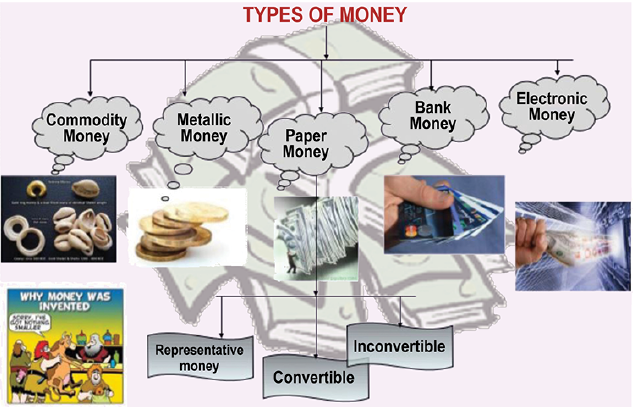
Consider the following:
1. Metallic Money
2. Representative Money
3. Commodity Money
4. Electronic Money
How many of the given above are the types of money:
Correct Answer:
(D)
All four
Ques: 6
Consider the following statements regarding Helicopter Drop:
1. It refers to increasing the supply of money in an economy.
2. It is an expansionary fiscal policy.
3. It involves printing large sums of money and distributing it to public.
Which of the statements given above are correct?
Correct Answer:
(D)
All of the above
Helicopter Money or Helicopter Drop
Helicopter Money or Helicopter Drop refers to increasing the supply of money in an economy through measures such as more spending, tax cuts, etc.
It is, basically, an expansionary fiscal or monetary policy that involves printing large sums of money and distributing it to the public in order to stimulate the economy.
The term ‘Helicopter Drop’ was coined by the American economist Milton Friedman in 1969.