Various Mudras under Buddhism MCQs with Explanations
About the Topic: Various Mudras under Buddhism covers the spiritual meanings and artistic representations of hand gestures like Bhumisparsha, Dharmachakra, and Dhyana Mudra.
Five perfections: Generosity, Morality, Patience, Effort and Meditative Concentration
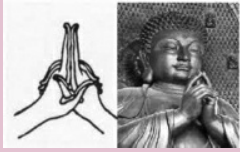
Uttarabodhi Mudra
Symbolizes perfection
How many of the pairs given above are correctly matched?
Correct Answer:
(A) Only one
Vajra Mudra: It indicates knowledge. This mudra is better known in Korea and Japan. In this mudra, the erect forefinger of the left hand is held in the fist of the right hand. It is seen in the mirror-inverted form also. This mudra signifies the importance of knowledge or supreme wisdom. Knowledge is represented by the forefinger and the fist of the right hand protects it. Hence, pair 1 is incorrect.
Varada Mudra: It indicates charity, compassion or granting wishes. In this mudra the right arm is extended in a natural position all the way down, with the palm of the open hand facing outwards towards onlookers. If standing, the arm is held slightly extended to the front. Can be a left-hand gesture as well. This Mudra signifies five perfections: Generosity, Morality, Patience, Effort and Meditative Concentration, through the five extended fingers. Hence, pair 2 is incorrect.
Karana Mudra: It indicates warding off evil. Hand is stretched out, either horizontally or vertically, with the palm forward. The thumb presses the folded two middle fingers but the index and little fingers are raised straight upwards. It signifies expelling demons and negative energy. The energy created by this mudra helps remove obstacles such as sickness or negative thoughts. Hence, pair 3 is incorrect.
Uttarabodhi Mudra: It means supreme enlightenment. Holding both hands at the level of the chest, intertwining all the fingers except index fingers, extending index fingers straight up and touching each other. This Mudra is known for charging one with energy. It symbolizes perfection. Shakyamuni Buddha, the liberator of Nagas, presents this Mudra. Hence, pair 4 is correct.
Ques: 2
The oldest sculpture of Buddha is made in which style?
Correct Answer:
(A) Gandhara Style
The oldest sculptures of the Buddha are typically associated with the Gandhara Style, which emerged in the 1st century CE. This style, influenced by Greco-Roman art, is known for its realistic and detailed representations of the Buddha, often featuring curly hair, draped robes, and a more human-like form. The Mathura style also developed around the same time but is generally considered slightly later than Gandhara in producing Buddha images.
Ques: 3
Name the ‘Mudra’ which is represented by the Gand haran Buddha image of Sarnath first Sermon.
Correct Answer:
(C) Dharm Chakra
The Gandharan Buddha image was inspired by Hellenistic realism, tempered by Persian, Scythian and Parthian models. The main subject of this art is based on the life of Buddha. The images consist of Dharma Chakra posture, Meditation posture, Abhaya posture and Varada postures of Gautama Buddha.
Ques: 4
Lord Buddha’s image is sometimes shown with the hand gesture called; “Bhumi Sparsha Mudra”. It symbolizes?
Correct Answer:
(B) Buddha’s calling of the Earth to witness his purity and chastity despite the temptations of Mara
In Bhumi Sparsha Mudra, Buddha is seen seated with his right hand as a pendant over the right knee stretching towards the ground with the palm inward while touching the lotus throne. The left hand can be seen with the palm upright in his lap. This gesture represents the moment of the Buddha’s awakening as he claims the earth as the witness of his enlightenment just before he realized enlightenment. It is believed that the demon Mara tried to frighten him with the armies of demons which represents the defeat of Mara and his demonic army by Buddha.
Ques: 5
Sarnath Buddha image of Bhumi Sparsha Mudra belongs to-
Correct Answer:
(D)
Gupta period
The Bhumisparsha Mudra of Gautama Buddha at Sarnath be longs to the Gupta period. This mudra represents steadfastness. The “Dhyani Buddha Akshobhya” also is associated with the earth witness mudra because he was immovable in keeping a vow never to feel anger or disgust at others. The mudra also symbolizes the union of skillful means (paya), symbolized by the right hand touching the earth and wisdom (prajna), symbolized by the left hand on the lap in a meditation posture.