Black holes
Black holes are thought to form as huge stars reach the end of their lives. The density of matter in a black hole cannot be quantified. The gravitational force is so strong that nothing can escape, including light. Black holes warp the space around them and can absorb nearby matter, including stars.
Parts of a Black Hole
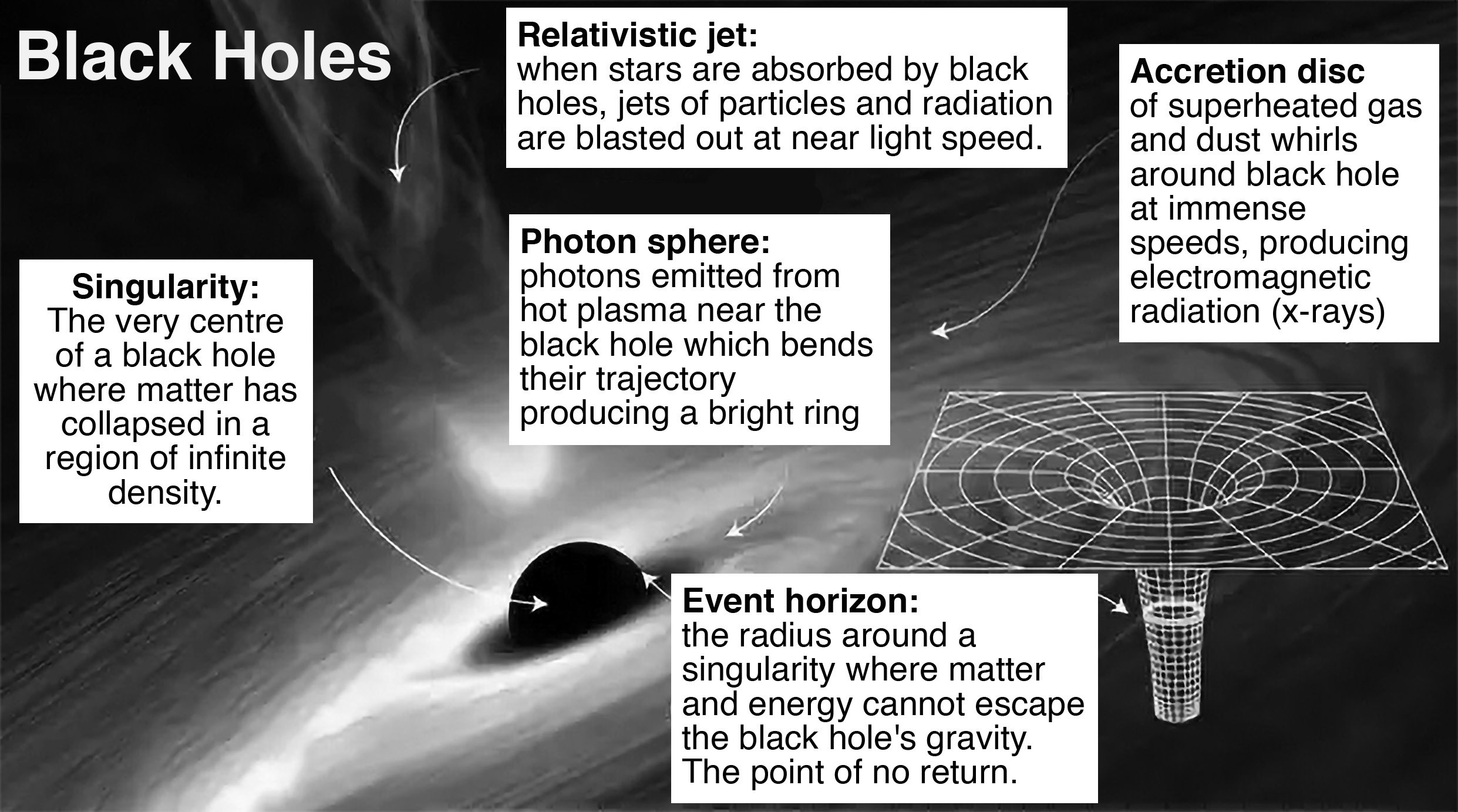
Accretion disc: A black hole's major source of light is an accretion disk. Black holes grow by eating matter (a process known as accretion) and merging with other black holes. A stellar-mass black hole partnered with a star may draw gas from it, whereas a supermassive black hole does the same with stars that go too close.
• The gas forms a hot, brilliant, swiftly rotating disk. Matter gradually moves from the outside edge of the disk to its inner edge, where it enters the event horizon. Isolated black holes that have absorbed the matter around them lack an accretion disk and can be extremely difficult to locate and analyze.
• Singularity: According to general relativity, the center of a black hole contains a place where matter is crushed to infinite density. It is the ultimate destination for anything that falls within the event horizon.
• Astronomers now do not know whether the singularity is a physical structure or just mathematical. The prediction of a singularity may indicate the boundaries of relativity, where quantum factors not included in the theory play a major role in a more complete description of gravity.
•
Event horizon: This is why a black hole is black. The event horizon can be thought of as the surface of a black hole. Inside this boundary, the velocity required to escape the black hole exceeds the speed of light, which is the fastest that anything can go. So, anything that enters the event horizon is doomed to remain within it, including light. Because light cannot escape, black holes neither emit nor reflect it, and no outside observer can learn anything about what is going on inside. Astronomers can, however, view black holes using light released by surrounding stuff that has not yet reached the event horizon.
• Photon Sphere : A photon sphere is a sphere-shaped (or, more commonly, an oblate-spheroid-shaped) surface region around a black hole that indicates the distance at which photons can orbit the black hole; any circling photon will be found on it. For a non-rotating black hole, it is 3/2 the Schwarzschild radius away from the center. Within the photon sphere, no object can continue an orbit without accelerating (e.g., using a force): it will either fall into the event horizon or escape the black hole. This phenomenon is completely attributable to strong- field gravity, and in principle (i.e., if its equation of state would support such a density), a neutron star may be dense enough to have an external photon sphere.