BLOCKCHAIN TECHNOLOGY
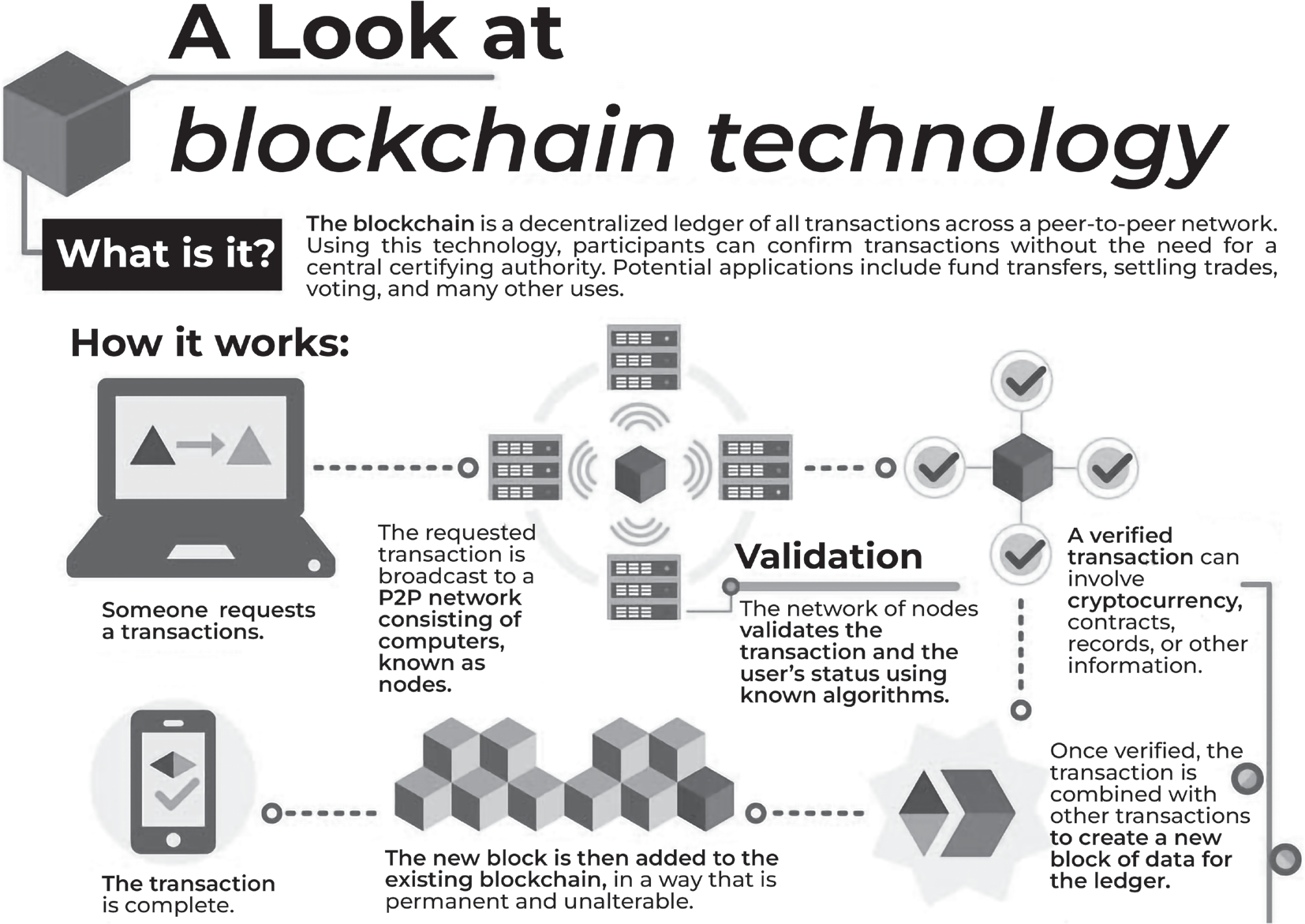
• The blockchain is a distributed database that stores records of all transactions or digital events that have been completed and shared by participating parties. The bulk of the system's participants verify each transaction.
• It holds every record of each transaction. Bitcoin is the most widely used cryptocurrency and an example of a blockchain. Blockchain technology initially became known when a person or group of people known as 'Satoshi Nakamoto' published a white paper titled "BitCoin: A peer-to-peer electronic cash system" in
2008.
•
Blockchain technology is a structure that stores transactional records (also known as block), of the public in several databases, known as the chain, in a network connected through Peer-to-peer (P2P) nodes.
• This storage is referred to as a digital ledger. Every transaction in this ledger (storage) is authorized by the digital signature of the owner, which authenticates the transaction and saves it from any tampering.
• Blockchain key characteristic features include decentralization, persistence and anonymity.
• Blockchain technology discards the need for any third-party or central authority for peer-to-peer transactions.
Importance of Blockchain
• Increased transparency: All transactions and data entries are permanently and transparently recorded in a blockchain. All transaction histories are visible to everyone on public blockchains, which are accessible to everyone.
• Third-party elimination: Blockchain technology is decentralized, in contrast to traditional databases, which are often kept on a third-party server. It is kept up to date
by a network of computers called nodes that take part in the blockchain data’s storage and validation.
Faster transactions: The speed of transactions in a blockchain network can be influenced by the consensus process employed. Certain consensus methods, such proof of work (PoW), which need a lot of processing power, cannot process transactions as quickly as proof of stake (PoS) or delegated proof of stake (DPoS).
Low transaction costs: In some circumstances, blockchain
technology may be able to lower transaction costs as compared to older systems. Blockchain eliminates the need for middlemen like banks, clearinghouses, or payment processors by enabling peer-to-peer transactions directly.
Enhanced security: The decentralization, immutability, and cryptographic methods of blockchain provide heightened security. Consensus algorithms are used to validate and add transactions to the blockchain; these techniques necessitate agreement from all participating nodes
Types of Blockchain
Public Blockchain
• The earliest kind of blockchain technology is a public blockchain. With the permissionless distributed ledger technology known as the public blockchain, anyone may sign up and start transacting. Every user maintains a copy of the ledger in this open version. It suggests that anyone with an internet connection can investigate the public blockchain.
• One of the earliest public blockchains that the general public had access to was the public blockchain. It enabled decentralized transactions to be carried out by anybody with an internet connection.
Private (or Managed) Blockchain
• A private blockchain is simplest defined as one that functions within restricted environments, such closed networks.
• It is also a blockchain that has permissions controlled by an entity. If a privately held company or organization wants to use a blockchain for private use cases, then private blockchains are great.
• It is possible to limit access to the blockchain network and make effective use of the blockchain. Additionally, the network settings that the firm can configure include accessibility permission.
Consortium Blockchain
• A consortium blockchain, often called a federated blockchain, is a creative solution for situations where an organization needs both public and private blockchain capability.
• In a consortium blockchain, some organizational features are visible to the public while others are not.
Hybrid blockchain
• It is one of the different types of blockchain technology. In particular, a hybrid blockchain could seem like a consortium blockchain, but it’s not. However, there might be some similarities between them.
• Combining a private and public blockchain is the simplest approach to define a hybrid blockchain.
How does it operate?
Peer-to-peer,instantaneous, frictionless, anonymous, and secure transactions are all made possible by the technology.
• It does this by distributing trust from powerful intermediaries to a large global network, which through a mass collaboration, clever code and cryptography, enables a tamper-proof public ledger of every transaction that’s ever happened on the network.
• A block is the “current” part of a blockchain that stores some or all of the most recent transactions. Once a transaction is finished, it becomes a permanent database
on the blockchain.
• A new block is created each time an existing block is finished. Every block contains a hash of the block before it, and they are connected to one another (like a chain) in a correct linear and chronological order.
Prospects
• The technology is being evaluated in a variety of businesses, with Bitcoin being only one of its uses.
• Areas that could benefit include banking, education, land records, healthcare and agriculture.
• Smart contracts backed by blockchain technology, which record all information, can make doing business easier.
• It will significantly lower the risk of fraud while enhancing a contract’s legitimacy, accuracy and efficiency.
• By lowering the possibility of insurance claim fraud, blockchain might be extremely important to the management of health insurance claims.
Challenges
• Blockchain technology is expensive to set up initially.
• The significant amount of energy required for blockchain to operate.
• Preserving the privacy of people and businesses, since blockchains are often public ledgers accessible to all parties.
• Not much is currently known about distributed ledger technology’s advantages.
Potential Applications of Blockchain Technology
• Asset management: Asset management is among the most popular uses of blockchain technology. Asset management is not an exception to the financial industry’s heavy reliance on blockchain. Asset management, in its broadest sense, is the administration and trading of many assets that a person may possess, including stocks, bonds, fixed income, real estate, mutual funds, commodities and other alternative investments.
• International Payments: Have you ever experimented with any Blockchain applications that facilitate cross- border payments in various currencies between nations? The money may not arrive at its destination for several days throughout this drawn-out, difficult process. By offering end-to-end remittance services without the need for middlemen, blockchain has contributed to the simplification of these cross-border transfers.
• Medical Care: Using smart contracts, blockchain can significantly impact the healthcare industry, which is one of the main uses for blockchain technology. With the help of these smart contracts two parties can enter into a contract directly from one another. Every party to the agreement is aware of its specifics, and when its requirements are fulfilled, the agreement is immediately put into effect.
• Internet of Things: The Internet of Things is a network of networked devices that can communicate with one another and gather information that can be utilized to make insightful decisions. Any connected system of “things” becomes an Internet of things. The Smart Home, where all household equipment, including lights, air conditioners, thermostats, smoke detectors and more, can be connected to one platform, is arguably the most well- known example of the Internet of Things.
National Strategy on Blockchain Technology
• It took a National plan to build a National Blockchain infrastructure in order to harness this new technology for service delivery and to guarantee social and economic advancement. This states that the Ministry of Electronics and Information Technology unveiled the National Strategy on Blockchain Technology in 2021.
• It envisioned advancing research and development, developing newer technologies, working with international partners and application development and building trusted digital platforms through a shared Blockchain infrastructure.
Objectives
• National Blockchain Infrastructure: By developing a National Blockchain infrastructure that can be utilized for the deployment and development of apps utilizing Blockchain-based technologies, it sought to establish a digital platform that could be trusted.
• Research and Development: In order to address issues with quick application development and its technological requirements, it intends to concentrate on research and development in the field of blockchain technology.
• Innovation Roadmap: The objective of this project is to develop an innovation roadmap that will enable Blockchain to become a reliable digital platform. It also seeks to overcome a number of obstacles to the implementation of blockchain technology.
•
Planning: The goal is to move toward a model of decentralized execution and centralized planning. Its scope would be broadened by the widespread use of Bitcoin technology across numerous industries.
• Diplomacy: Increasing India’s participation in international organizations,research facilities, and innovative projects involving Blockchain technology.
Global efforts towards Blockchain Technology
• As part of its plans to enhance communication and data exchange amongst its smart city infrastructure, China has devised a Blockchain-based identifying system. Additionally, China unveiled the Blockchain-based Service Network initiative, designed to assist businesses and individuals in implementing Blockchain applications more quickly and affordably.
• With the use of blockchain technology, the European Blockchain Partnership hopes to create a reliable and secure European Blockchain Services Infrastructure for rules and cyber security.
• To authenticate electronic records, the Estonian government makes use of blockchain technology through the Keyless Signature Infrastructure.
• The Smart Dubai program was introduced by the United Arab Emirates with the goal of making Dubai the first metropolis entirely powered by blockchain technology. It also seeks to use blockchain technology to improve everything from environmental sustainability and traffic management to healthcare and education.
• The United States’ Food and Drug Administration uses Blockchain technology to address the issues of security and transparency in the handling of health data. To improve food traceability, the UK also tracks the distribution of meat using blockchain technology.
Blockchain in Social sectors
• Personal Identification: Huge volumes of personal data, including information from birth and death certificates, marriage licenses, passports and census data are
managed by governments.
• Fight corruption: Enabling government transactions on the blockchain facilitates the creation of a reliable transaction history and greatly streamlines the auditing procedure. This would help increase the transparency of public procurement.
• Cut red tapism: Blockchain removes this lack of interoperability, which results in needless red tape when requesting pertinent information from a user. It also simplifies and lowers the cost of data sharing between agencies.
• Identity and Land rights: The World Identity Network
and Humanized Internet project can store identifiers such as birth certificates and university degrees on a blockchain, in the form of distributed digital lockboxes.
Way Forward
• With all of its potential, blockchain has to have its business viability and weaknesses carefully considered.
• We require a solid and informative data repository prior to integrating blockchain into the public sector data handling system.
• Linking IndiaChain with Aadhar, and therefore creating a secure personal identity for all Indians.
• Appropriate laws governing the nation’s adoption of blockchain technology.