Cell Division- Mitosis and Meiosis
There are two types of cell division. One for growth which produces diploid cells (2n) and the other for reproduction which produces haploid cells (n). Think back to the earlier discussion and imagine sperm and ovum combine to form zygote. Since, both gametes have only half the number of chromosome, the zygote has the complete chromosome needed for growth. Now when it will divide to form more cells, will it do haploid cell production or diploid cell production?
For growth, since the number of chromosomes required are the same (2n) every time, the cell division will be to ensure the production of cells with complete number of chromosomes. That is, why every cell in your body has the same DNA and genetic information. Because all of the cells in your body can be traced back to when you were a zygote and started dividing.
When cell division happens for growth, producing the diploid cells which have the same number of chromosomes, and when it leads to the passage of complete DNA of the parent to successor cells, it is called as mitosis. (Baby you Big you)
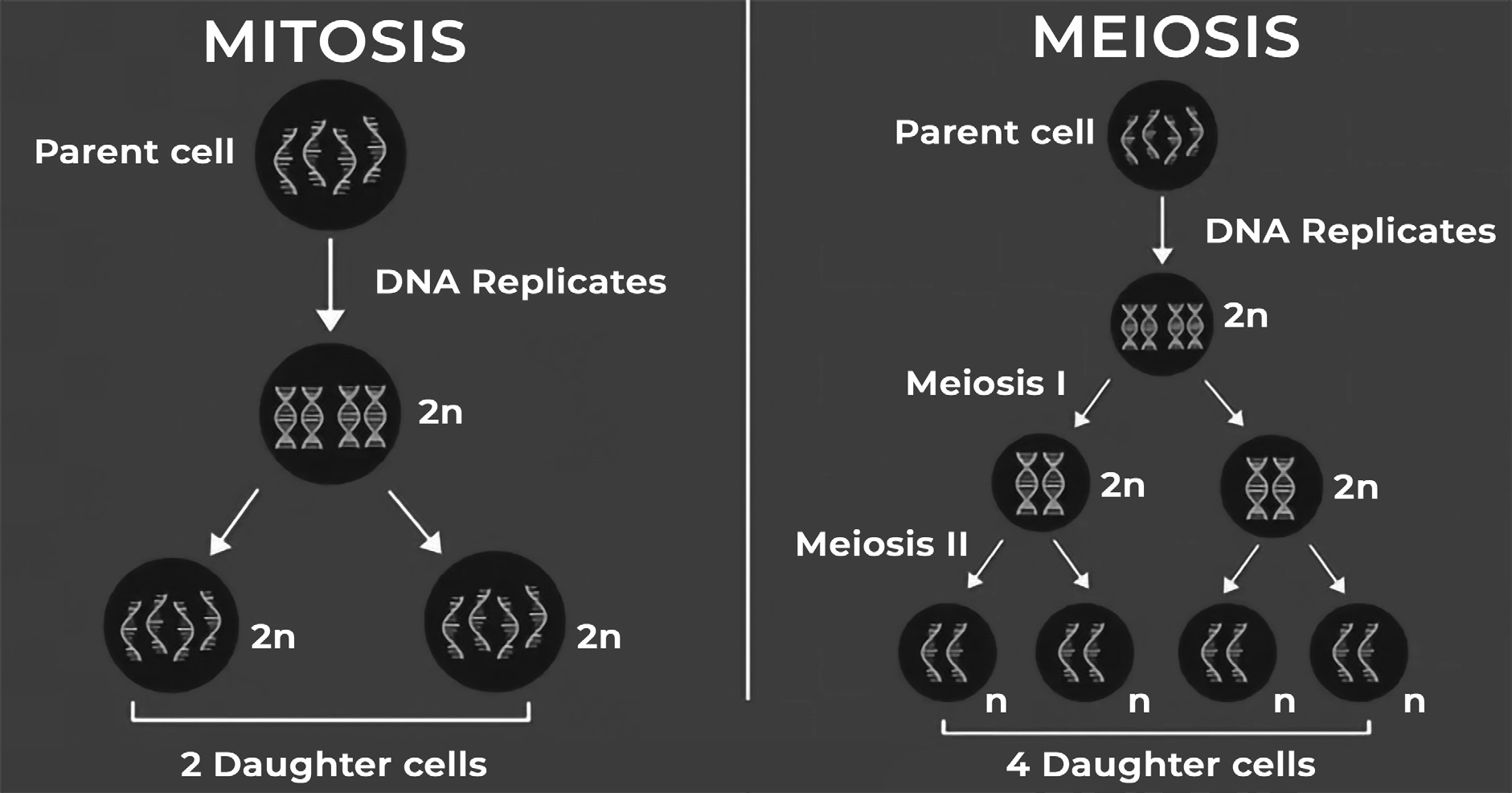
When cell division happens for reproduction, producing the haploid cells, which have half the number of chromosomes, and when it leads to the passage of only half of the DNA of the parent to successor cells, it is called as meiosis. (From your mother and father Baby you)