DEOXYRIBONUCLEIC ACID (DNA): A DETAILED LOOK
DNA has information to code for certain proteins needed for the body. This information from the DNA is first converted into RNA through the process called transcription and then finally into protein or enzymes through the process called translation.
The DNA molecule is very long and has to store a lot of information. In fact, the DNA can be divided into Coding and Non- Coding Regions. Coding regions, means those parts or regions of the DNA which code for proteins. Whereas, the non-coding regions are those which do not code for any proteins.
The part of the DNA that codes for a protein is also called as gene. It is the DNA in these genes that codes for proteins. The famous double-helix structure of DNA was determined in 1953 by scientists James Watson, Francis Crick, Maurice Wilkins, and Rosalind Franklin.
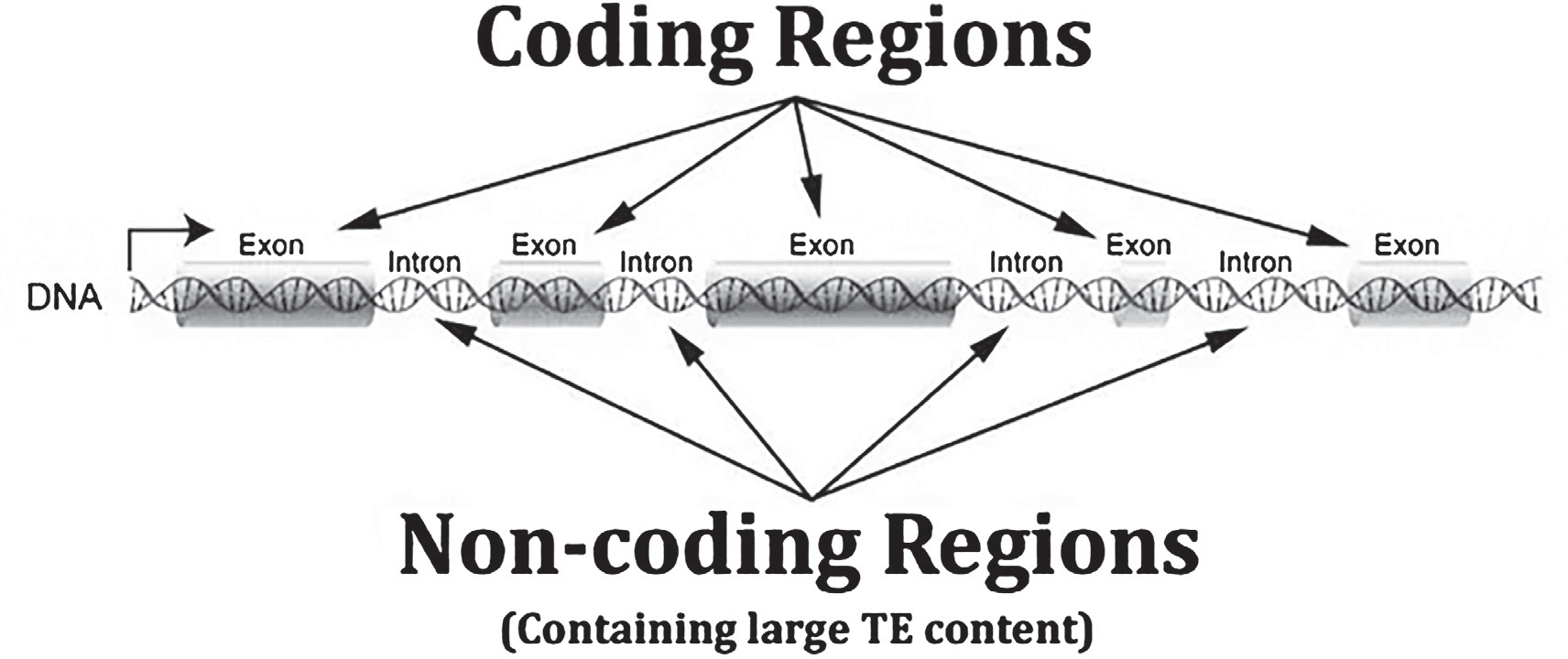
Why is there non-coding region in the DNA?
The non-coding region of the DNA provides the stability to the DNA molecule. In addition, some of the non-coding part of the DNA provides some functional role such as regulation of gene expression, while other areas of non-coding region have no known functions.
Consider a DNA Molecule as shown above. The circles represent the gene or the coding parts. While the other normal DNA is the non-coding part of the DNA.
The non-Coding part of the DNA will have more differences than the gene or the coding region of the DNA. The coding part of the DNA (genes) will have very slight differences between different people. The Non-Coding part, since it is not as important has way more differences among different individuals. This finds application in identifying people through DNA fingerprinting works. Since lots of differences between different individuals is stored in the non-Coding region of the DNA, this region can also be used to effectively and uniquely identify individuals.
Ribonucleic acid (RNA): Ribonucleic acid (RNA) is a molecule that is present in the majority of living organisms and viruses. It is made up of nucleotides, which are ribose sugars attached to nitrogenous bases and phosphate groups. The nitrogenous bases include adenine, guanine, uracil, and cytosine