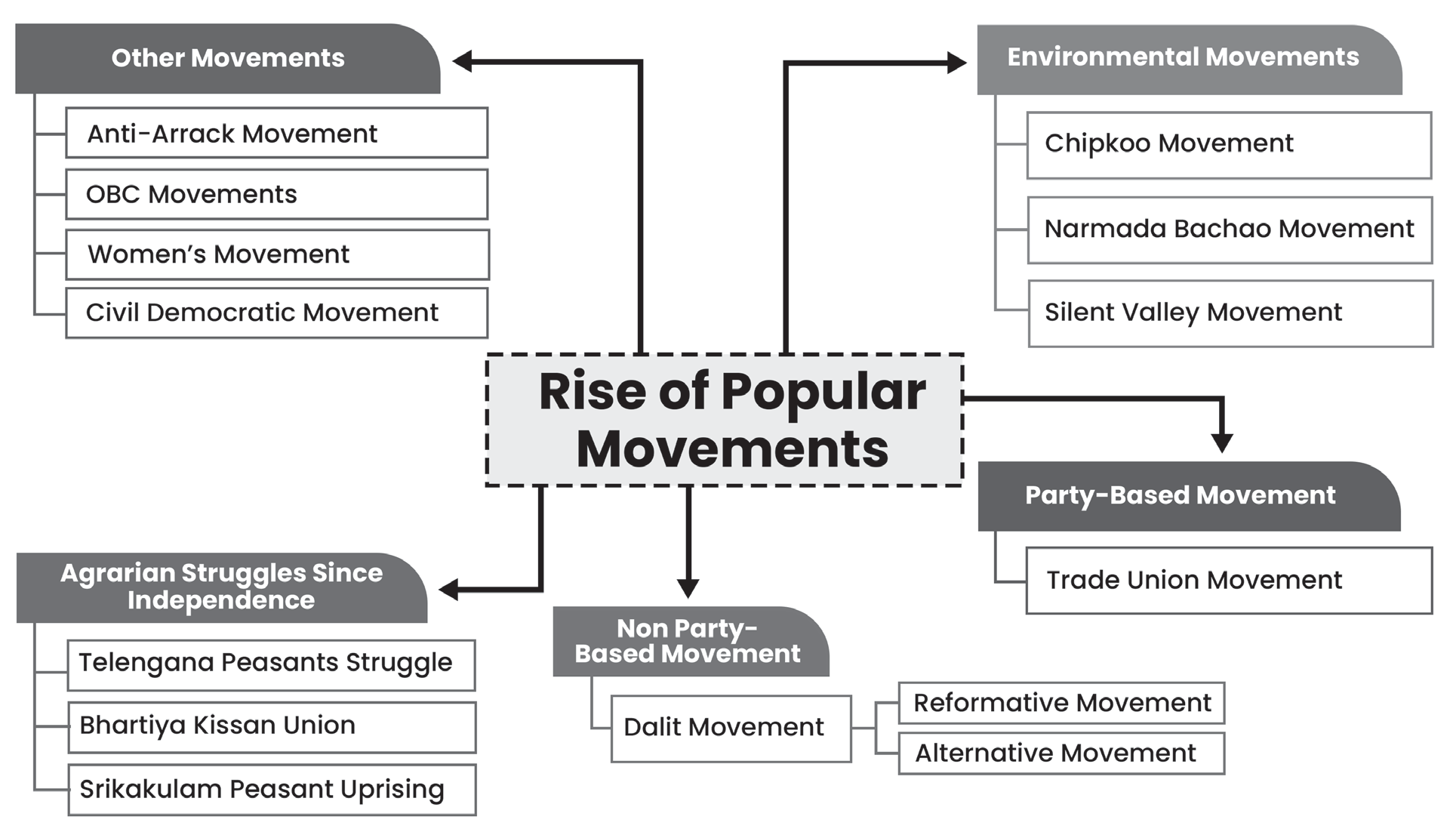
We will explore the dynamic landscape of popular movements that have shaped the socio-political fabric of India. From environmental activism to Dalit and women's movements, we will look into a diverse array of societal change and resistance.
• According to Paul Wilkinson, the concept of Social Movements means a deliberate collective endeavour to promote change in any direction and by any means not excluding violence, illegality, revolution or withdrawal into the utopian community.
• Ghanshyam Shah classifies movements as revolt, rebellion, reforms and revolution to bring about changes
in the political system. According to Parth Mukherji, social movements are accumulative, alternative and transformative in nature.
• Some other classify movements on the basis of the participants such as peasants, tribal, Dalits, women, backwards, students, etc. Many other movements that are based on issues transcending the barriers of class have been termed New Social movements.
Environmental Movements
Chipko Movement:
• The Chipko movement began in a few villages in Uttarakhand when the forest department denied villagers permission to cut ash trees for making agricultural tools. Meanwhile, the same land was allotted to a sports manufacturer for commercial purposes.
• This decision angered the villagers, leading them to protest against the government’s actions. The movement quickly spread across the Uttarakhand region.
• It raised broader concerns about the ecological and economic exploitation of the area.
• The villagers demanded that forest-exploiting contracts should be reserved for locals and that local communities should have control over natural resources like land, water, and forests. They also called for government support in providing low-cost materials to small industries while ensuring regional development without disrupting the ecological balance.
• The movement highlighted economic issues, particularly
those of landless forest workers, and called for guarantees of a minimum wage.
• One of the unique aspects of the Chipko movement was the active participation of women.
• Forest contractors in the region also served as alcohol suppliers to men, and women took a strong stand against alcoholism, broadening the movement’s scope to include other social issues.
• The movement achieved success when the government imposed a 15-year ban on tree felling in the Himalayan region until the green cover was fully restored. More importantly, the Chipko movement, which began over a single issue, became a symbol of many popular movements that emerged across India in the 1970s and beyond.
Narmada Bachao Andolan:
• In the early 1980s, an ambitious developmental project was initiated in the Narmada Valley of central India. The project aimed to build 30 large dams, 135 medium- sized dams, and around 3,000 smaller dams across the Narmada and its tributaries, spanning three states: Madhya Pradesh, Gujarat, and Maharashtra.
• Among the key components of the project were the Sardar Sarovar Project in Gujarat and the Narmada Sagar Project in Madhya Pradesh. These dams were designed to provide drinking water, water for irrigation, generate electricity, and boost agricultural production.
• However, the project also required the relocation of around 250,000 people, and 245 villages were expected to be submerged. Initially, local communities demanded proper relocation and rehabilitation. By the late 1980s, this issue evolved into a major movement under the banner of the Narmada Bachao Andolan (NBA), a loose coalition of local voluntary organizations.
• The NBA called for a comprehensive cost-benefit analysis of major developmental projects across the country. It also pushed for the inclusion of social costs in these evaluations, emphasizing the displacement of people, loss of livelihoods and culture, and the depletion of ecological resources as critical factors.
• The movement’s persistent efforts led to the recognition of the right to rehabilitation by both the government and the judiciary. One notable achievement was the National Rehabilitation Policy, introduced by the government in 2003, which can be attributed to the advocacy of movements like the NBA.
• NBA employed various democratic strategies to further its demands, including protests, dharnas, gheraos, rasta roko, jail bharo movements, and hunger strikes. Medha Patkar, a prominent social activist, emerged as the most visible face of the movement.
Silent Valley Movement:
• The Silent Valley Movement was launched to protect the Silent Valley, an evergreen forest located in Kerala’s Palakkad district. In 1973, when the government proposed the construction of a dam on the Kuntipuzha River, the area was earmarked as an ideal site for hydroelectric power. This sparked the “Save Silent Valley” movement, led by the Kerala Sasthra Sahitya Parishad (K.S.S.P), which successfully mobilized public opinion to save the forest.
• In 1982, the government formed a multidisciplinary committee chaired by M.G.K. Menon, with Madhav Gadgil, Dilip K. Biswas, and others as members, to evaluate whether the hydroelectric project could proceed without significant ecological harm. In 1983, the committee’s report led to the Prime Minister’s decision to abandon the project.
• The movement culminated in 1985 when Prime Minister Rajiv Gandhi inaugurated the Silent Valley National Park, which was designated the core area of the Nilgiri Biosphere Reserve. Silent Valley is also home to the endangered lion-tailed macaque, making its conservation even more crucial.
Fisheries Movement:
• In both the eastern and western coastal regions of India, numerous families from indigenous fishing communities depend on fishing for their livelihood. Their way of life was threatened when the government allowed mechanized trawlers and practices like bottom trawling for large-scale fish harvesting in Indian waters.
• To defend their interests, these fishermen united under the National Fish Workers Forum (NFF). The NFF’s first major victory came when it successfully opposed the government’s decision to allow commercial vessels, including multinational corporations, into the deep sea for fishing.
Throughout the 1990s, the NFF waged a series of legal and public campaigns, fighting to protect the subsistence fishermen rather than those seeking profit from the sector. In July 2002, the NFF organized a nationwide strike against the government’s plan to issue licenses to foreign trawlers. The NFF also forged alliances with global organizations to safeguard both the ecology and the livelihoods of fish workers