The Europe in the “Middle Ages” | 500 to 1400/1500 CE
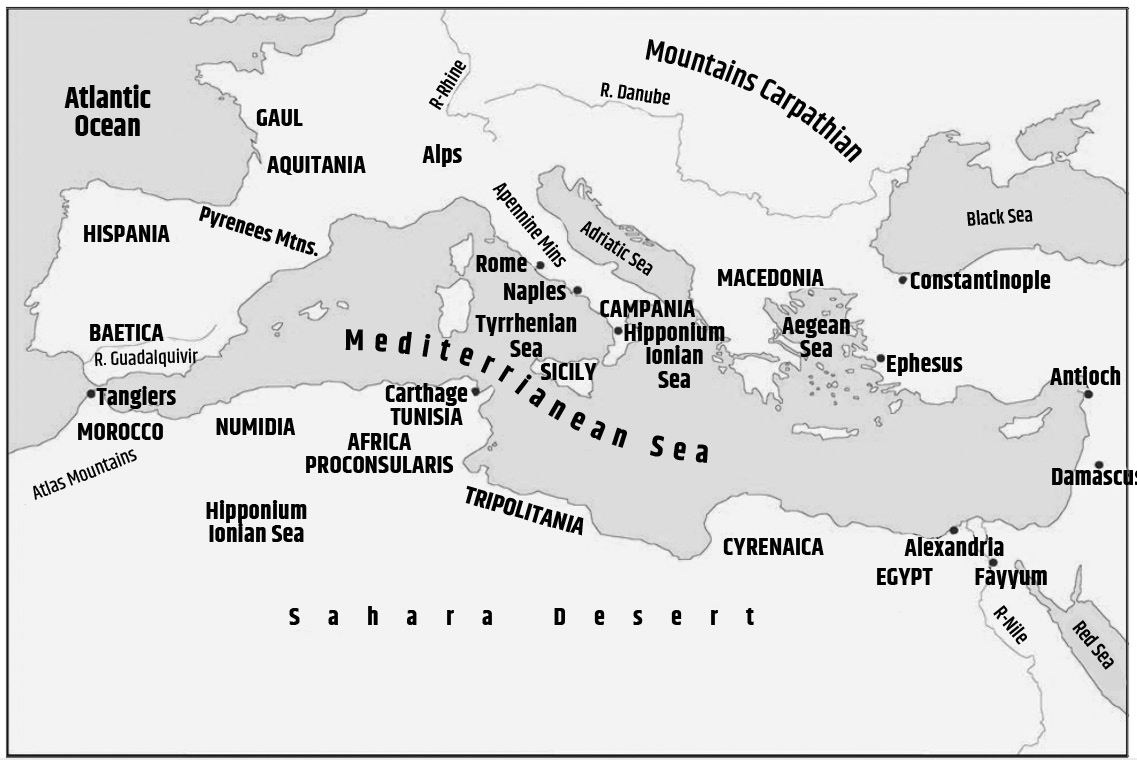
Map: Europe in the Middle Ages
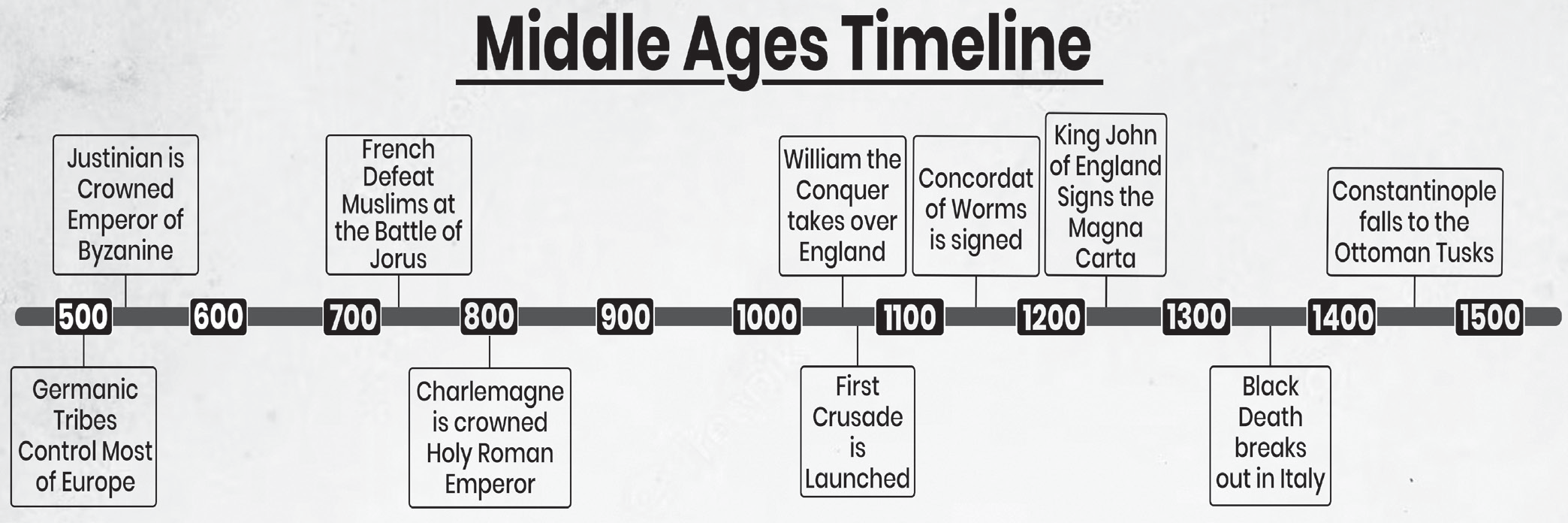
The term “Middle Ages” refers to the era in Europe from 476 CE to the Renaissance in the 14th century, however experts argue it is incorrect since it indicates an interval between two more major epochs, referring to the “medieval period.
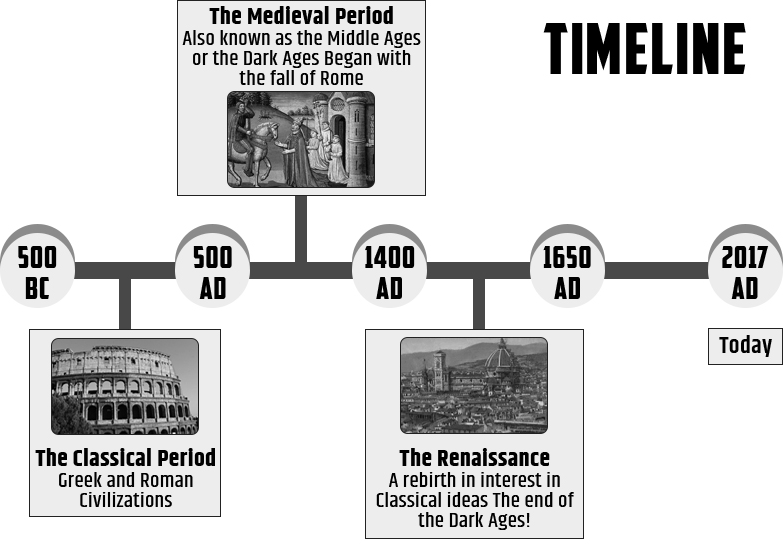
• Starting in the 14th century, European thinkers, writers, and artists began to celebrate the art and culture of ancient Greece and Rome. They labeled the period that followed as the “Middle Ages” or the “Dark Ages,” claiming that medieval society had abandoned the achievements of earlier civilizations in favor of “barbarism and religion.” This view dominated for centuries, but today, scholars acknowledge the Middle Ages as a dynamic and multifaceted era.
The Catholic Church in the Middle Ages
• After the fall of Rome, the Catholic Church emerged as the most powerful institution of the medieval period, with its leaders drawing authority from strategic alliances and the promise of protection.
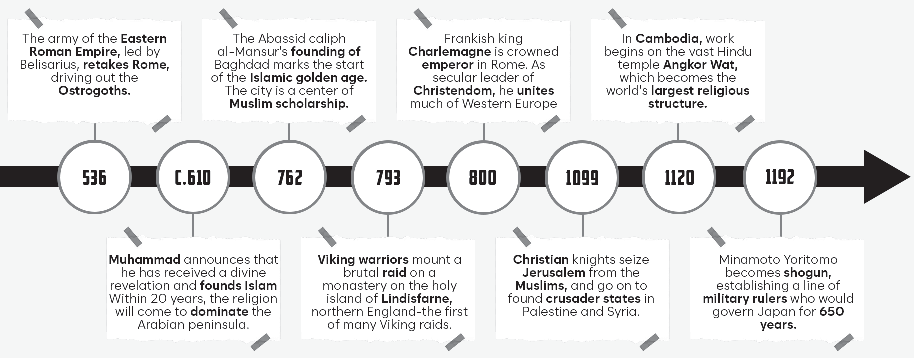
• In 800 CE, Pope Leo III crowned the Frankish king Charlemagne as “Emperor of the Romans,” effectively.
reviving the Roman Empire in the West for the first time since its collapse in the 5th century. His reign marked the beginning of what became known as the Holy Roman Empire.
• Many political entities across Europe aligned themselves with the Church’s interests. Meanwhile, ordinary people were required to pay a tithe—10% of their annual produce or earnings—to support the Church and its clergy. The Church itself, however, was largely exempt from taxation, enabling it to accumulate vast wealth and influence.
• By the 6th century, the Pope often wielded more power than kings, with the ability to enforce his authority across Christian Europe. Monasteries, originally founded as centers of learning and moral guidance, also served to aid the poor-but over time, corruption these institutions.
The Rise of Islam
• After the death of the Prophet Muhammad in 632 CE, the Islamic world expanded rapidly as Muslim forces united the Middle East under a single caliphate.
• At its height, the medieval Islamic world was more than three times the size of the Christian world.
• In major cultural and intellectual centers like Cairo, Baghdad, and Damascus, poets, scientists, and philosophers wrote thousands of influential works.
Classical texts from Greece, Iran, and India were translated into Arabic, while innovations such as the pinhole camera, soap, windmills, surgical instruments, and even a primitive flying machine were developed.
• The Quran, along with other sacred texts, was studied and taught by religious scholars and mystics, helping to spread Islamic thought and spirituality throughout the region.
The Crusades
• In the 11th century, the Catholic Church sanctioned the Crusades—military campaigns aimed at driving Muslim "infidels" from the Holy Land.
• Crusaders, identifiable by the red crosses they wore, believed that participating in these campaigns would earn them forgiveness of sins and eternal salvation.
• The Crusades began in 1095 and continued intermittently until the 15th century.
• In 1099, Christian forces successfully captured Jerusalem, leading to an influx of pilgrims from Western Europe. However, many of these pilgrims were robbed or killed during their journeys.
• In 1118, a French knight named Hugues de Payens founded the Knights Templar, a military order that earned papal backing and became known for its fierce combat abilities.
• The fall of Acre in 1291 marked the end of the last Crusader stronghold in the Holy Land, and in 1312, Pope Clement V officially disbanded the Knights Templar.
Impact of the Crusades
• The Crusades had no true victor; instead, they resulted in the deaths of countless individuals on both sides.
• Despite the violence, the Crusades helped unite ordinary Catholics across Europe, sparking a wave of religious enthusiasm—even among those who had previously felt disconnected from the official Church.
• Additionally, Crusaders encountered the rich intellectual traditions of the Islamic world, including its literature, science, and technology—exchanges that would leave a lasting influence on European thought and learning.
The Middle Ages: Economics and Society
• In medieval Europe, Feudalism was the system in which monarchs awarded enormous lands to noblemen and bishops, with landless peasants known as ‘serfs’ working on the lands.
• In exchange for labour, serfs were permitted to reside on the property and were given security in the event of an enemy attack.
• However, in the 11th century, agricultural improvements such as the heavy plough and three-field crop rotation made farming more effective, reducing the need for farm laborers.
• This resulted in an increasing population, attracting more people to towns and cities.
• The Crusades also opened up commercial lines to the East, introducing Europeans to imported products such as wine, olive oil, and textiles.
• Port cities prospered as the commercial economy grew, with 15 towns in Europe having a population of over 50,000 by 1300.
• In these cities, a new era was born: the Renaissance. The Renaissance was a time of great intellectual and economic change, but it was not a complete “rebirth”. It had its roots in the world of the Middle Ages.
Feudalism
Feudalism, derived from the word ‘feud’, referred to a social and economic system prevalent in Western Europe during the Medieval period (600-1500 AD). It divided society into rigid classes, lacked central authority, and relied on self-sufficient villages. This led to a decline in trade and towns. The Feudal Lords controlled society’s affairs, with the King being less powerful. Peasants were exploited, and ‘Serfdom’ (feudal labour) became a significant feature. The Church’s influence extended beyond religious matters in Europe