German Unification
Prussia: After the Frankfurt Assembly failed to unify Germany in 1848 and 1849, the German people began to look to Prussia for leadership in the unification effort. By the 19th century, Prussia had emerged as a strong and prosperous state with an authoritarian government. The Prussian king exercised tight control over both the government and the military, and the state was known for its emphasis on militarism, or dependence on military power.
Nationalism in Europe
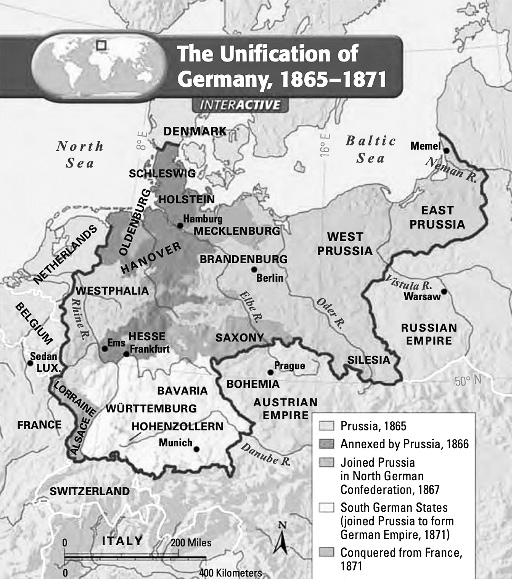
In the 1860s, King William I sought to expand the Prussian army. When the Prussian legislature refused to approve new taxes to fund the proposed military reforms, William I appointed Count Otto von Bismarck as the new prime minister.
Count Otto von Bismarck
Count Otto von Bismarck is often considered the leading practitioner of realpolitik in the 19th century. Realpolitik, or the “politics of reality,” focused on practical matters rather than ideals or ethics. Bismarck was known for his unapologetic opposition to anyone who stood in his way. Upon his appointment, he ignored the legislative opposition to his military reforms, asserting that “Germany does not look to Prussia’s liberalism but to her power.” He collected taxes and strengthened the military, governing Prussia from 1862 to 1866 without parliamentary approval, all while pursuing an aggressive foreign policy.
Unification Process: Bismarck’s journey to German unification began with the defeat of Denmark in 1864, with Austria’s assistance. Prussia gained control of the duchies of Schleswig and Holstein. In 1866, Bismarck stirred tensions with Austria, forcing them into war. The Austrians, unable to match the disciplined Prussian army, were decisively defeated by July 3. Prussia then united the northern German states into the North German Confederation. The southern German states, primarily Catholic, were wary of Prussia’s Protestant dominance but feared France more, and thus, they formed military alliances with Prussia.
War with France: By 1870, Prussia had established dominance over northern Germany, which began to concern France. Bismarck understood that a united Germany would pose a threat to French security. In 1870, a dispute over a relative of the Prussian king becoming the King of Spain gave Bismarck the opportunity to provoke France into war. He manipulated the situation, leading to France declaring war on July 19, 1870. This conflict, known as the Franco-Prussian War, saw French forces swiftly defeated by the superior Prussian army. The southern German states honored their alliances with Prussia, and Prussian armies advanced into France. On September 2, 1870, at Sedan, a French army and Napoleon III were captured. Paris surrendered on January 28, 1871, and a peace treaty was signed in May, with France paying a hefty indemnity and ceding the provinces of Alsace and Lorraine.
Unification Complete: Before the war’s end, the southern German states agreed to join the North German Confederation. On January 18, 1871, in the Hall of Mirrors at the Palace of Versailles, Prussian King William I was crowned Kaiser of the newly unified German Empire. The Prussian monarchy and military had accomplished German unity. With its industrial strength and military power, the new German state emerged as the most formidable force in Europe, embodying Prussia’s authoritarian and militaristic values.
Conclusion
Nationalism in Europe, as it evolved from the late 18th century to the 20th century, represents a complex and transformative force that profoundly reshaped the continent. Initially emerging as a response to the feudal monarchies and empires of the time, it was galvanized by the French Revolution’s ideals of self-determination and sovereignty. Throughout the 19th century, nationalism catalyzed the unification of fragmented states and the breakup of multi- ethnic empires, leading to the emergence of powerful nation- states like Germany and Italy.
While Nationalism played a crucial role in fostering a sense of unity and identity among diverse groups, it also sowed the seeds of conflict, as competing national aspirations often led to tensions and wars. The 20th century saw the destructive consequences of extreme nationalism, particularly in the form of two World Wars and the horrors of ethnic cleansing. Nevertheless, the post-war era witnessed a push towards European integration, with the European Union serving as a counterbalance to narrow nationalism.