Green Revolution
Green Revolution in India is known to reduce the dependence of India on foreign aid for the supply of food grains during agricultural crises like droughts, floods etc. and envisaged to make India a self- dependent and self-sustained nation in terms of food grains availability.
Prevailing conditions before the introduction of the Green Revolution
Indian agriculture in the early post-independence years mainly focused on institutional reforms, without giving much attention to improving the technological foundation needed to boost productivity.
Although agricultural output grew by an impressive 3% annually between 1949 and 1965, food shortages became a growing issue from the mid-1950s onwards. This was largely due to a combination of factors: the rapid population growth after independence, a steady rise in per capita income, and the massive financial commitments towards planned industrialization, all of which placed significant long-term pressure on agriculture.
By the mid-1960s, two consecutive monsoon failures in 1965 and 1966 further compounded the agricultural strain, contributing to a 17% decline in agricultural output and a 20% drop in food grain production.
Inflation, which had been under control until 1963, began to rise sharply, reaching 12% annually between 1965 and 1968, with food prices soaring by nearly 20% each year. This inflation was driven partly by the droughts and partly by the economic strain from the wars with China in 1962 and Pakistan in 1965, which led to a significant increase in defense spending.
To cope with the food crisis, India had to import larger quantities of food, with the United States being the primary supplier of food grains. However, after the 1965 Indo-Pak war and India’s stance on Vietnam, the U.S. suspended its food aid, refusing to renew the PL-480 wheat loan agreement on a long-term basis.
Given these dire circumstances in the mid-1960s, ensuring economic self-reliance and achieving food self-sufficiency became top priorities for the Indian leadership.
Initiatives before the green revolution to boost agriculture
There was a wrong perception prevailing during Nehru’s era that he had neglected the agriculture sector and instead focused too much on rapid industrialisation. But contrary to this perception, Nehru had placed great importance on creating the physical and scientific infrastructure essential for Indian agriculture.
There were massive large-scale irrigation and power projects like Bhakra Nangal, various agricultural universities, research laboratories, and fertiliser plants were set up
Introduction of Green Revolution
The Green Revolution in India unfolded in three distinct phases, with each phase bringing significant changes to agriculture in different regions of the country.
First Phase (1962-65 to 1970-73): The initial phase saw a sharp increase in wheat yields, particularly in the north-western regions of Punjab, Haryana, and Western Uttar Pradesh. This phase marked the beginning of the shift towards modern agricultural practices with the introduction of High Yielding Variety (HYV) seeds and other technologies.
Second Phase (1970-73 to 1980-83): The second phase extended the reach of HYV seed technology from wheat to rice. During this period, the technology spread across Uttar Pradesh, Andhra Pradesh (especially in coastal areas), parts of Karnataka, Tamil Nadu, and later Maharashtra and Gujarat. These regions also experienced a significant boost in agricultural production.
Third Phase (1980-83 to 1992-95): The third phase of the Green Revolution saw a broader geographical spread, reaching regions with previously low agricultural growth, such as Orissa, West Bengal, Madhya Pradesh, and Rajasthan. This phase brought encouraging results and helped improve agricultural productivity in these areas as well.
During the last phase, the Southern region registered a higher rate of growth than the Northern region. By the end of this phase, the ‘coefficient of variation’ of the output growth levels and yield [per hectare] level between the various states dropped substantially compared to earlier decades. By the end of the last phase, there was a considerable reduction in regional inequality with an increase in prosperity in rural India.
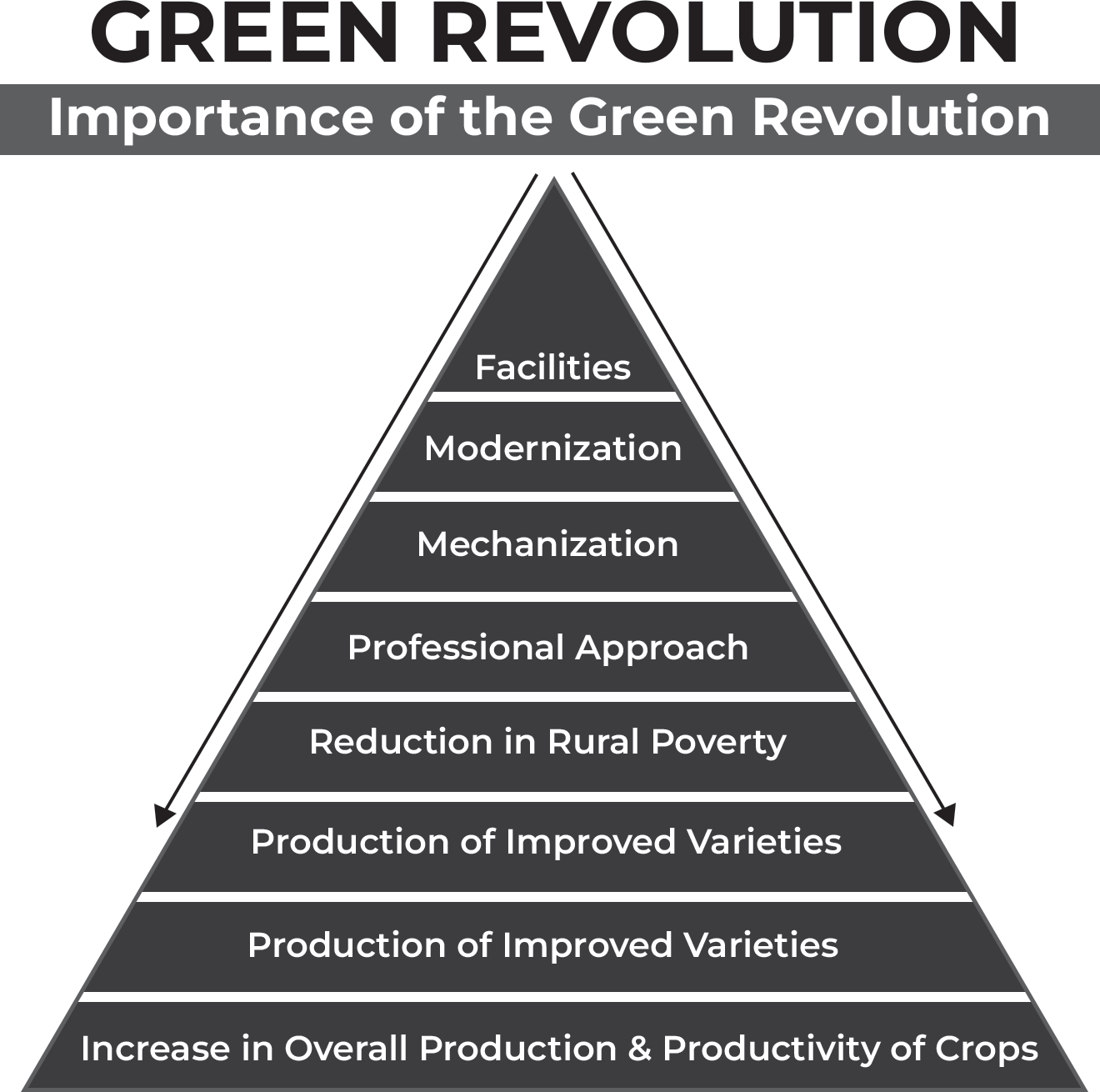
The adoption of the Green Revolution strategy of introducing a package of high-yield variety (HYV) seeds, fertilisers and other inputs in a concentrated manner to some suitable select areas paid immediate dividends in creating food security and poverty reduction. Between 1967–68 and 1970–71, food grain production rose by 35 per cent.
Significant government initiatives during Green Revolution Period
Government investment in agriculture rose significantly. Institutional finance in the agriculture sector doubled from 1968 to 1973.
The agricultural prices commission was set up in 1965 and efforts were made to assure the farmers a sustained remunerative price.
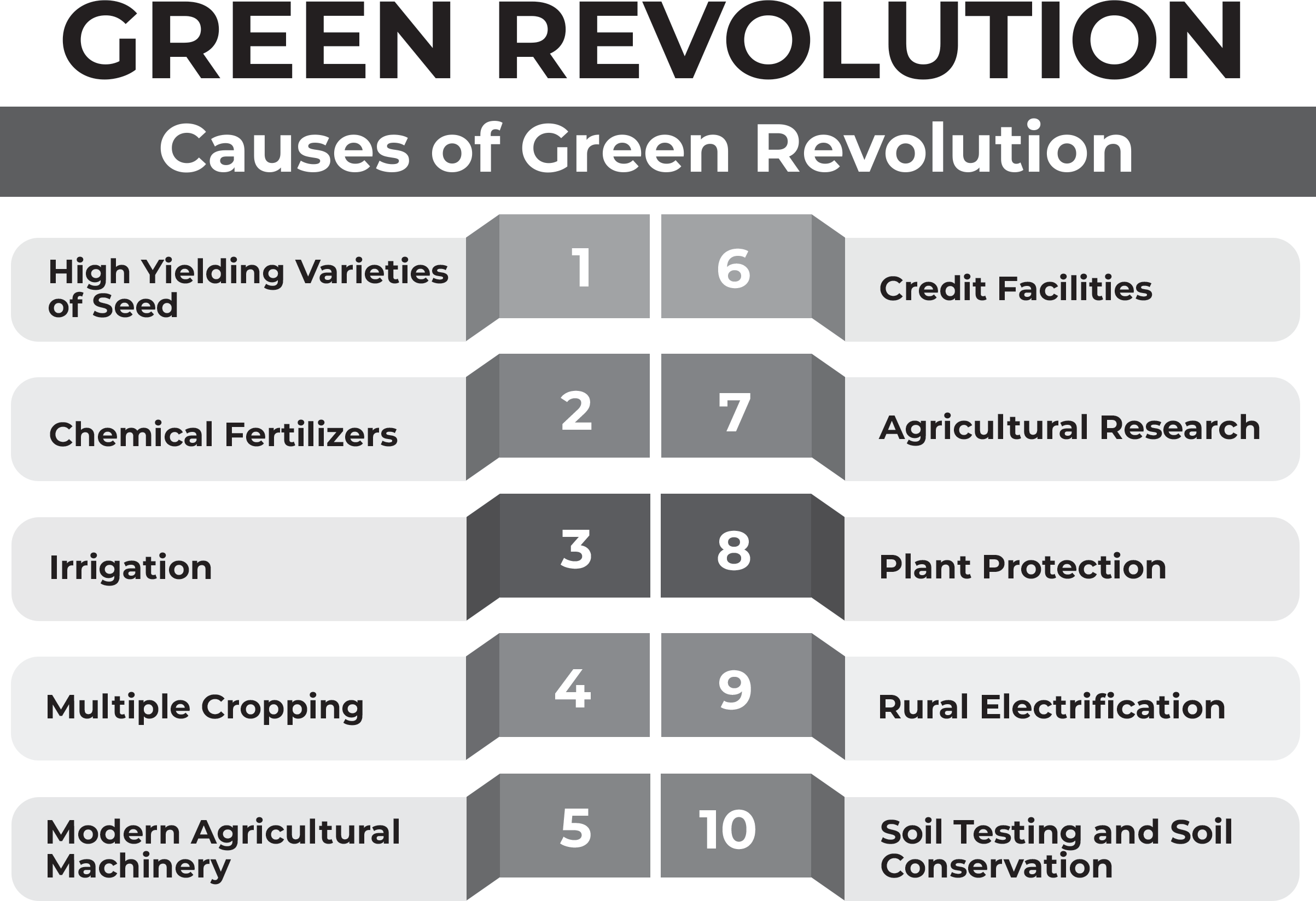
Public investment, institutional credit remunerative prices and availability of new technology at low prices raised the profitability of private investment by farmers.
The result of the government’s initiative was that the rate of increase in the gross irrigated area rose from 1 million hectares per annum in Pre-Green Revolution to about 2.5 million hectares per annum during the 1970s.