Italian Unification
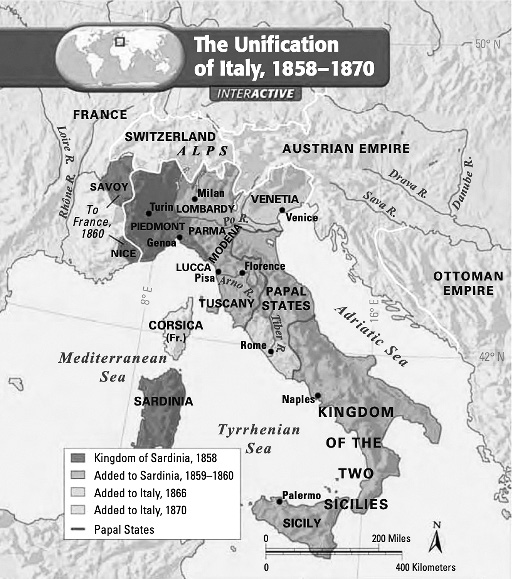
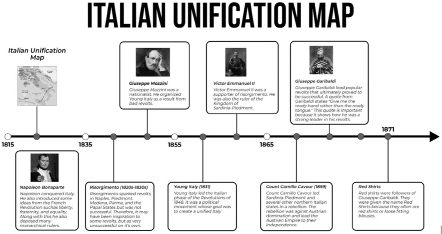
By 1850, Austria remained the dominant power on the Italian Peninsula. After the failure of the 1848 revolution, many Italians began to look to Piedmont, a northern Italian state, for leadership in unifying the country. The Kingdom of Piedmont, ruled by the Savoy royal family, included Piedmont, Sardinia, Nice, and Savoy. King Victor Emmanuel II became the ruler in 1849.
In 1852, Camillo di Cavour became the prime minister. A committed and pragmatic leader, Cavour focused on economic expansion to boost government revenues and strengthen the kingdom’s military.
Aware that Piedmont’s army was not strong enough to challenge Austria, Cavour sought an alliance with French Emperor Napoleon III. He provoked Austria into declaring war in 1859. The subsequent peace settlement resulted in Nice and Savoy being ceded to France in exchange for their alliance. Lombardy, previously under Austrian control, was now part of Piedmont, while Austria retained control over Venetia.
Nationalist Fervor
Cavour’s success inspired nationalists in other Italian states—such as Parma, Modena, and Tuscany—to overthrow their own governments and unite their territories with Piedmont.
• At the same time, a new figure emerged in southern Italy to lead the unification effort. Giuseppe Garibaldi, a devoted Italian patriot, assembled a volunteer force of
a thousand men. Known as the Red Shirts, they earned their name from the distinctive color of their uniforms.
Garibaldi’s Unification Drive:
A branch of the Bourbon dynasty ruled the Kingdom of the Two Sicilies, which included Sicily and Naples. In 1860, a revolt erupted in Sicily against the Bourbon king. Garibaldi and his volunteer forces landed on the island and, by July, had seized control of most of it. In August, Garibaldi crossed over to the mainland and launched a successful campaign up the Italian Peninsula. By early September, Naples and the entire Kingdom of the Two Sicilies had been conquered.
Garibaldi chose to hand over his territorial gains to Piedmont. On March 17, 1861, the unified Kingdom of Italy—now including Sicily and Naples—was officially declared under the rule of King Victor Emmanuel II.
However, Italian unification was still incomplete. Austria continued to hold Venetia in the north, and Rome remained under papal control, protected by French troops.
Unifying Rome: Austro-Prussian War
• Italy gained control of Venetia following the Austro- Prussian War of 1866. The new Italian state had allied with Prussia, and after Prussia’s victory, Italy was rewarded with Venetia.
• In 1870, during the Franco-Prussian War, French troops withdrew from Rome. This allowed the Italian army to move in and annex the city on September 20, 1870.
• With the annexation of Rome, it became the capital of the newly unified Italian state