Radcliffe Commission and Demarcation of Boundaries
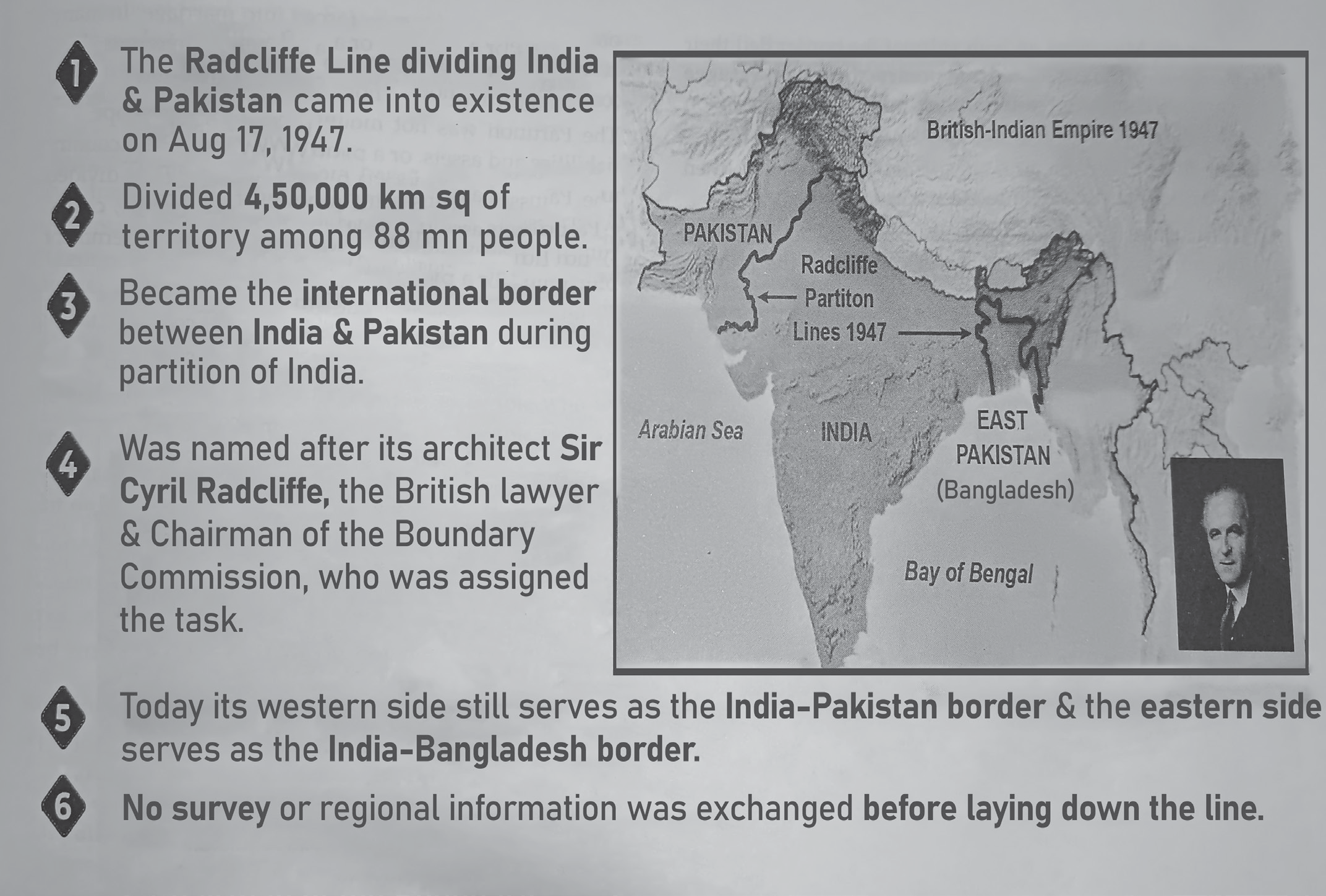
A very important task at hand was the demarcation of boundaries. After the 3rd June plan of Mountbatten, a British jurist Sir Cyril Radcliffe was invited to fix the problem and to form two boundary commissions: one for Bengal and one for Punjab. Four other members were also there in commission, but there was a deadlock between Congress and the Muslim league. On 17th August 1947, he announced his award.
Implications of the Radcliffe Award
It was decided to follow the principle of religious majorities, which means that areas, where the Muslims were in the majority, would make up the territory of Pakistan. The remaining was to stay with India.
There were two areas of concentration with a Muslim majority, In the West and East parts of India. Hence, it was decided that the new country will comprise two territories, West and East Pakistan.
Not all Muslims were in favour of joining Pakistan. Khan Abdul Ghaffar Khan, also called Frontier Gandhi, was the undisputed leader of the North-West Frontier Province and he staunchly opposed the two-nation theory. But as Khudai Khidmatgar of Abdul Ghaffar Khan boycotted the Plebiscite due to the provision of limited franchise rights in that, the lone contender in the fray, the Muslim League, won the vote by default and in the end, NWFP was made to merge with Pakistan.
Two Muslim-majority concentrated provinces of British India, Punjab and Bengal had very large areas with a non- Muslim population in the majority. Eventually, it was decided that these two provinces would be bifurcated according to the religious majority at the district or even lower level. The partition of these two provinces caused prolonged trauma.
The last difficult position was of “minorities” on both sides of the border. Minorities then on either side lived in fear and fled from their homes to save their lives from the brutal violence unleashed during the partition.
Limitation of this award
Sir Cyril Radcliffe had never been to India or anywhere else in Asia and was not familiar with the demographics of India.
He had no specialised knowledge needed for the task as well. He had no advisors and experts.
Six-week deadline that Radcliffe had was also a limitation of this award.
The loss of Lahore, the erstwhile capital of the Sikh Empire, which had a Muslim majority, to Pakistan, was a particularly hard blow to the Sikh community.
There were disputes regarding the Radcliffe Line’s award of the Chittagong Hill Tracts and the Gurdaspur district. Disputes also evolved around the districts of Malda, Khulna, and Murshidabad in Bengal and the sub- division of Karim Ganj of Assam.