REGIONAL SCHOOL OF PAINTINGS
Even though the medieval period was dominated by the Mughal style of painting, the sub-imperial Schools developed by developing their own style
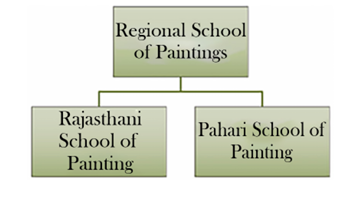
Rajasthani Schools of Painting
• The term ‘Rajasthani Schools of Painting’ refers to the schools of painting that flourished between the sixteenth and early nineteenth centuries in the princely kingdoms and thickens of what is now roughly Rajasthan and parts of Madhya Pradesh, such as Mewar, Bundi, Kota, Jaipur, Bikaner, Kishangarh, Jodhpur (Marwar), Malwa, Sirohi and other such principalities.
• Features of Rajasthani School of Painting:
• Impact of the cults of Vaishnavism, Shaivism and Sakti
• Bold lines and powerful contrasting colors
• The influence of the Mughals
• Use of paper, ivory and silk as canvas.
Mewar School of Painting
• Nathdwara and Deogarh were the main centres of Mewar school. The remarkable figure of Sahibdin dominates early Mewar paintings. The Rasikapriya, the Ramayana and the Bhagavata Purana are all shown by Sahibdin during this period of Mewari art. The style of Mewar paintings shifted after Sahibdin’s death. The majority of the paintings showed life in Mewar’s courts. The remarkable ‘tamasha’ paintings, which depict court rituals and city views in unprecedented detail, are a highlight of this period.
Kishangarh School of Painting
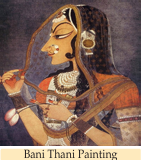
• The most romantic legends - Sawant Singh and his lover Bani Thani – and the merging of life and mythology, romance and bhakti are all shown in Kishangarh’s paintings. The Painting of Bani Thani was made by Nihal Chand. They also painted a lot about Radha and Krishna’s spiritual and romantic relationships.
Bundi School of Painting
• Hadoti is the name given to the twin kingdoms of Bundi and Kota. The sister republics, which were founded by splitting the elder Bundi kingdom between two brothers, have histories and artistic traditions that are inextricably linked. The monarchs of Bundi and Kota were devoted Krishna believers, and in the 18th century, they declared themselves to be mere regents, ruling on behalf of the god who was the genuine king (similar worship patterns can also be seen in Udaipur and Jaipur). Paintings of natural vegetation were detailed in the Bundi school. In the artwork, human faces were spherical with a pointy snout. The sky is painted in various colors, with a red ribbon visible most of the time.
Amber-Jaipur School of Painting
• The Amber school is also known as the ‘Dhundar’ school, and its oldest evidence can be seen in Rajasthan's Bairat wall paintings. The palace walls and mausoleum of Amer palace in Rajasthan also have some paintings. Despite the fact that some of the guys are depicted in Mughal-style attire and headdress, the paintings have a folk-style finish. In the 18th century, during the reign of Sawai Pratap Singh, this school attained its pinnacle. Suratkhana, or painting department, produced miniatures to accompany the Bhagavata Purana, Ramayana, Ragamala and a variety of portraits
Marwar School of Painting
• Jodhpur and Bikaner, both controlled by the Rathods and Jaisalmer, ruled by the Bhati dynasty, make up one of the vast schools of painting. Jodhpur, like Bikaner, was a desert kingdom that prospered thanks to its ties to the Mughals. The men and ladies in paintings from the 15th and 16th centuries wore brightly coloured attire. They followed Mughal traditions throughout this time, but after the 18th century, the Rajput element grew more prominent, as seen by an influx of paintings with a linear rhythm and bright colors. Many excellent paintings may be seen in the Jodhpur atelier but the attention has always been on the exceptional paintings created during Man Singh’s (1803-1843) reign and beyond
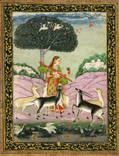
Pahari School of Paintings
• Pahari painting is an umbrella word for a type of Indian paintings that originated in the Himalayan hill kingdoms of North India and are mainly done in miniature size. In terms of design and colour, it is quite comparable to Rajput paintings. These paintings were largely done in miniature painting forms throughout the era of the 17th to 19th centuries when they were formed and developed. Pahari painting evolved from Mughal painting, albeit it was primarily patronised by Rajput rulers who dominated many sections of the region and it gave rise to a new idiom in Indian painting
• Based on their regional diversity, Pahari paintings in India can be divided into two groups.
• Basohli and Kullu Style - Chaurapanchasika style
• Guler and Kangra Style - Calm colours and modification Features of Pahari school of painting
• The representation of the eternal love of Hindu deities Radha and Krishna is the core topic of Pahari art.
• Multiple figures appear on the canvas, all of them are animated.
• The composition, colour and pigmentation of each figure are unique
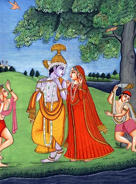
Jammu Kashmir Style of Pahari School of Painting
Basohli Paintings
• Basohli Paintings are famous in the Kathua region of Jammu and Kashmir. This town has produced a remarkable Devi series, a spectacular series of the Supreme Goddess’s incarnations. The exquisite portrayal of the Rasamanjari text is likewise well-known. Basohli paintings are characterised by geometrical designs, brilliant colours and shiny enamel.
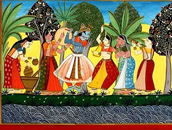
Jammu Paintings
• Jammu paintings have a striking resemblance to Kangra paintings. Jammu painters created the Shangri Ramayana in the late 17th and early 18th centuries.
Jasrota Paintings
• Jammu and Kashmir is home to the majority of Jasrota paintings. It revolves around kingly events, court scenes, symbolic scenes and so on.
Mankot Paintings
• Paintings from Mankot can be found in Jammu & Kashmir. It looks a lot like the Basohli kind. It makes use of vibrant colours and striking subjects. Portraiture became a popular motif in the mid-seventeenth century. Later on, realism and muted colours became more prominent.
Himachal Pradesh Style of Pahari School of Painting
• Chamba Paintings
The style of Chamba paintings is comparable to that of Mughal art. It is heavily influenced by the Deccan and Gujarat painting styles.
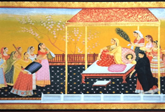
Bilaspur Paintings
• Around the mid-seventeenth century, this town witnessed the growth of Pahari art. Painters created paintings on coverlets for sacraments and rites in addition to the Bhagavata Purana, Ramayana and Ragamala series.
Guler-Kangra Style Paintings
• Around the year 1800, the Guler Kangra painting style was formed. It was a naturalised version of the artwork, with noticeable differences in the treatment of the eyes and face modelling. Landscapes were also frequently shown in Guler Kangra art. This style also emphasised Indian women’s grace and delicacy.
Garhwal Paintings
• When painters from outside the region settled in Srinagar, Garhwal Paintings began. The Mughal style was first dominant. Later, it came to reflect a more straightforward interpretation of Kangra customs.
Kulu Paintings
• Two Madhumalati manuscripts, the Bhagavata Purana and other Kulu-style paintings are included.
Mandi Paintings
• From 1684 through 1727, Mandi witnessed the birth of a new school of painting under Raja Sidh Sen. The king was depicted as a monstrous person with exaggeratedly large heads, hands and feet in the paintings. Other pieces featured geometric configurations and delicate, realistic features.
Nurpur Paintings
Himachal Pradesh is home to the Nurpur paintings. Bright colours and flat backgrounds are common in Nurpur paintings. Later periods substituted subdued colours for the bright ones.