Star Formation
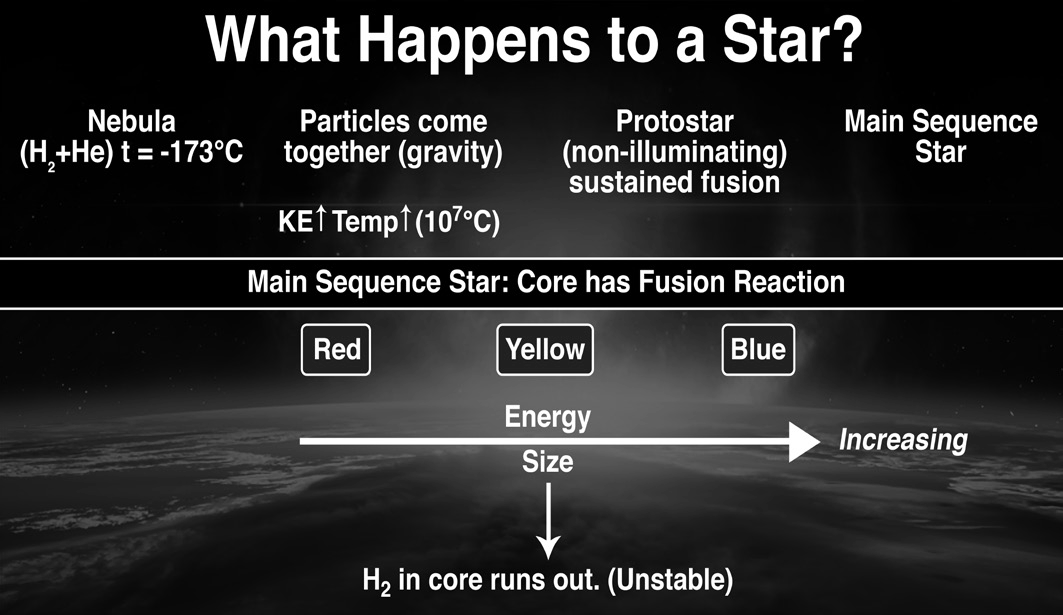
There are many stages involved in star formation:
A nebula is a cloud of gas (mostly hydrogen and helium) and dust in space. Nebulae are the birthplaces of stars.
Protostar: an early stage of a star creation where nuclear fusion is yet to commence.
T Tauri Star: a young star undergoing gravitational contraction, halfway between a protostar and a low-mass main sequence star.
Main Sequence Star: For example, the Sun is in full life, with nuclear fusion occurring at its core.
Small stars are classified as Red Giants and massive stars as Red Supergiants.
Planetary Nebula (small stars) and Supernova (big stars).
Importance of Supernova
When a star’s core runs out of hydrogen, it begins to die. The dying star swells into a red giant, which then begins to produce carbon by fusing helium atoms. More massive stars begin a new cycle of nuclear burning. These stages produce a wide spectrum of elements, including oxygen and iron. During a supernova, the star emits massive amounts of energy and neutrons, allowing metals heavier than iron, such as uranium and gold, to be formed. All of these elements are ejected into space during a supernova explosion, resulting in the formation of new stars. Thus, every element on Earth was generated by a supernova explosion!
Neutron stars
Neutron stars are mostly composed of neutrons and are formed during a supernova, which forces protons and electrons to combine to form a neutron star. A neutron star is extremely dense (a mass three times that of the Sun can be contained into a sphere only 20 kilometers across). If its mass increases, its gravity will be so intense that it will shrink even further, eventually becoming a black hole. Chandrasekhar Limit: The limit is the maximum mass at which a star nearing the end of its life cycle can become a white dwarf and collapse into a neutron star or black hole.