The Outbreak of the Revolution
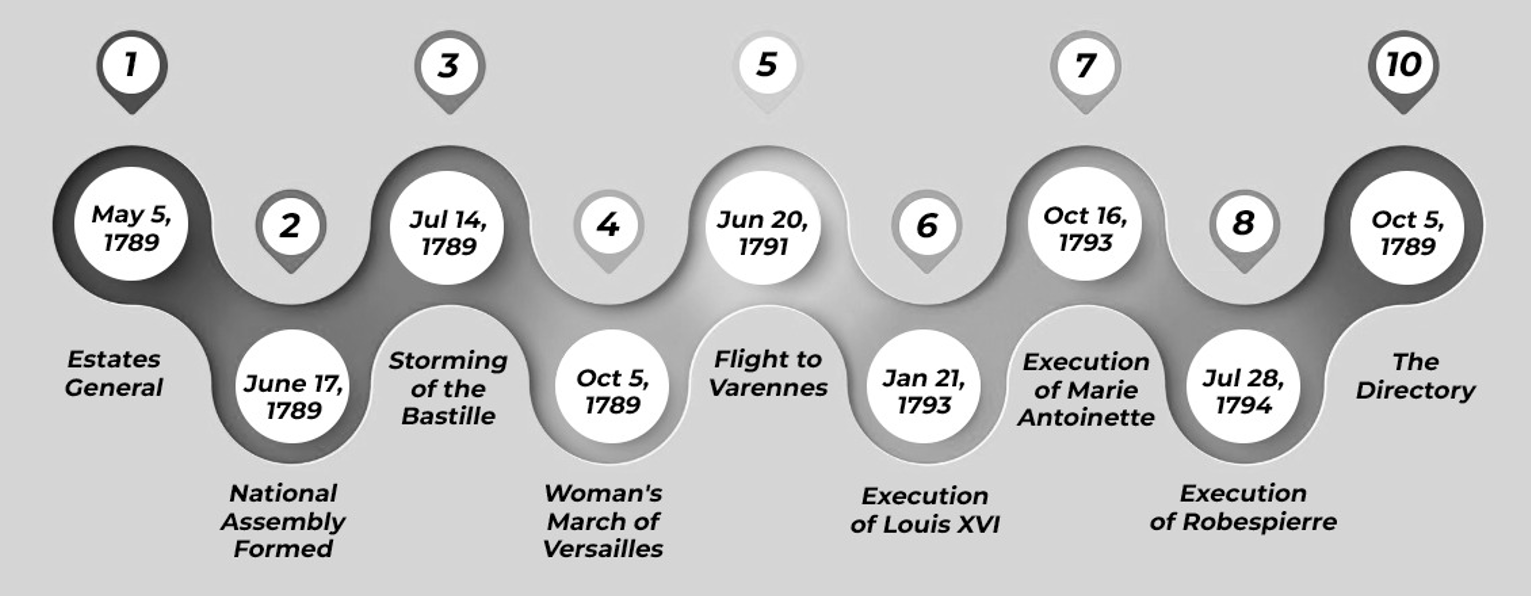
The Summoning of the Estates General, 5 May 1789: The Beginning the Bourgeois Revolution On 5 May 1789, Louis XVI called together an assembly of the Estates General to pass proposals for new taxes.
• Out of total, the 1214 elected representatives, the clergy, constituting the First Estate, accounted for 308, the aristocrats of the Second Estate numbered 285 and the Third Estate numbered 621.
• In the past, voting in the Estates General followed the principle of one vote per estate. Louis XVI intended to maintain this system. However, the members of the Third Estate demanded a new approach—voting by head,
where each individual member would have one vote. When the king rejected their proposal, the Third Estate members walked out of the assembly in protest.
• On June 20, the members of the Third Estate gathered in the hall of an indoor tennis court at the Palace of Versailles. They boldly declared themselves the National Assembly and took an oath not to disband until they had created a constitution for France that would limit the king’s power. This moment became known as the Tennis Court Oath, with key figures like Mirabeau and Abbe Sieyes leading the charge.
• Faced with this defiance, King Louis XVI was forced to agree to the demand for the Estates to meet together, breaking the tradition of separate sessions. This concession marked a crucial turning point and signalled the beginning of the end for the Ancient Regime.
The Fall of the Bastille, 14 July 1789
• Paris, the nerve center of French politics and administration, erupted in celebration following the bourgeoisie’s triumph at Versailles. However, the joy was short-lived. On 12 July, King Louis XVI dismissed the popular finance minister Necker and ordered troops to surround Paris, triggering widespread unrest.
• Riots and looting quickly spread across France and reached alarming levels in Paris. On 14 July, thousands of revolutionary Parisians stormed the Bastille—a fortress prison that, although nearly empty, had come to symbolize the tyranny of the Bourbon monarchy. Around 8,000 people broke into the fort, killed the guards, and seized the weapons stored inside.
• The fall of the Bastille had profound consequences. It marked the collapse of royal absolutism in France, led to the lifting of press censorship, and confirmed the power of armed revolt. Within three days, the king withdrew the army and reinstated Necker. The aristocratic plot had been crushed, at least temporarily.
• A permanent committee formed earlier in Paris to coordinate resistance evolved into the Paris Commune, with Jean Sylvain Bailly appointed as mayor. To maintain order and protect property, the National Guard was established.
In a symbolic gesture, King Louis XVI visited Paris and appointed Marquis de Lafayette as commander-in-chief of the National Guard. As a result, administrative control of Paris shifted to the bourgeoisie. Furthermore, the fall of the Bastille ignited a wave of peasant revolts across the French countryside, deepening the revolutionary momentum.
The Spread of Rural Unrest
• The peasant revolt erupted in the French provinces in the wake of the fall of the Bastille and the setting up of the Paris Commune.
• Trouble had already broken out in the rural areas as early as December 1788 as the rural masses were discontented by feudal oppression.
• There was also an economic crisis and so, under the circumstances, the peasants of all the provinces of France stopped paying tithe. They refused to pay dues to their feudal lords and carry out their feudal duties.
• The attack on property unleashed in the wake of this widespread peasant revolt taught the members of the National Assembly a vital lesson.
• It became evident that in order to ensure the safety of property, some swift concessions would have to be granted to farmers and the feudal burden had to be removed.
• In a decree on 4 August 1789 as the clergy and aristocracy surrendered their special privileges and feudalism collapsed: the Ancient Regime came to an end.
The Work of the French Constituent Assembly
• The pledge to frame a new constitution made with the Tennis Court Oath of June 1789 by the representatives of the Third Estate finally materialized on 30 September 1791.
• When the Estates General started working on a new constitution, it became a Constituent Assembly and was the new focus of the Revolution.
• The newly elected National Assembly, renamed National Convention, first met in a session on 22 September 1792.
• The new constitution created what came to be called a constitutional monarchy. The power of enacting legislation to curb royal authority became vested in the unicameral legislature.
• The king had no authority to dissolve the Assembly. The principle of national sovereignty became applicable in all spheres administration. The French administration was completely decentralized.
• The new judicial system introduced by the Constituent Assembly enabled people, irrespective of their social status, to seek justice.
• The king no longer wielded power over the judiciary and, following the separation of powers; the executive had no control over the judiciary.
• In 1789 the old tax system was virtually abolished. Steps were taken to improve the fiscal condition of the government, i.e., tax was imposed on every landowner and on industry and commerce.
• Religious reform laws were codified in France with the Civil Constitution of the Clergy on 12 July 1790. The Church of France was made subservient to the state under the new law and the clergy thereafter became government employees.
Emergence of Political clubs
• Political clubs quickly became key places for people to gather, discuss government policies, and plan their actions. Among these, the Jacobin Club emerged as the most influential. The club took its name from the former St. Jacob convent in Paris.
• The Jacobin Club mainly attracted members from the lower, less affluent classes of society. These included small shopkeepers, artisans like shoemakers, pastry chefs, watchmakers, printers, as well as servants and day labourers.
• At the helm of the club was Maximilien Robespierre, who became its most prominent leader.
National Convention (1792- 95)
• On the inaugural day, the members unanimously declared France to be a republic (1792), i.e., the First French Republic.
• The members, despite their unanimous declaration, were sharply divided in their opinions. The Girondist- Jacobin conflict basically centered around the leadership of the Convention.
• The Girondists, ideologically speaking, held that under the Republic it was necessary to consolidate the successes of the revolution. For the Jacobins, on the other hand, the fruits of the revolution could not reach the people with mere declaration of the Republic.
• This accounted for sharp differences between the Girondists and Jacobins over the future of the deposed King Louis XVI.
• Louis XVI was sentenced to death by a court on the charge of treason. On 21 January 1793 he was executed publicly.
The Reign of Terror
• The period from 1793 to 1794 is known as the Reign of Terror. During this time, Robespierre implemented strict policies of control and harsh punishment.
• Anyone he considered an ‘enemy’ of the republic such as former nobles, clergy, members of rival political groups, and even dissenting members of his own party—was arrested, imprisoned, and brought before a revolutionary tribunal. If found ‘guilty,’ they were executed by guillotine.
• Robespierre enforced his policies with such intensity that even his allies began calling for moderation. Eventually, in July 1794, he was tried and found guilty by a court. He was arrested and executed by guillotine the following day.
A Directory Rules France
• The fall of the Jacobin government allowed the wealthier middle classes to seize power.
• A new constitution was introduced which denied the vote to non-propertied sections of society.
• The system established two elected legislative councils, which were responsible for appointing a five-member executive body known as the Directory.
• This structure was intended to prevent the concentration of power in the hands of a single leader, as had happened under the Jacobins.
• However, frequent conflicts arose between the Directors and the legislative councils, with the latter often attempting to remove members of the Directory.
• This ongoing political instability eventually created the conditions for the rise of a military dictator—Napoleon Bonaparte.
Rise of Napoleon to Power
• In 1804, Napoleon Bonaparte declared himself Emperor of France.
• With ambition to expand his empire, he set his sights on neighboring European countries, dismantling old dynasties and establishing new kingdoms, often placing his own family members at the helm.
• Napoleon saw himself as a force for modernizing Europe. He implemented significant reforms, such as safeguarding private property and introducing a standardized system of weights and measures based on the decimal system.
• At first, many viewed Napoleon as a liberator, bringing freedom and progress to the people. However, over time, his armies began to be seen as an invading force, imposing foreign rule.
• Napoleon’s reign came to an end with his defeat at
•
Waterloo in 1815. Nevertheless, the revolutionary ideas he spread throughout Europe, particularly regarding liberty and modern laws, left a lasting legacy