The World at War
The immediate and apparent cause of the Second World War was Germany’s invasion of Poland on September 1, 1939.
This attack marked the official beginning of the war.
The German army advanced from the west and conquered Poland within three weeks. Although Britain and France declared war on Germany, Poland received no effective military assistance.
Taking advantage of the situation, the Soviet Red Army moved in to reclaim territories that had once been part of the Russian Empire. By 1940, the Soviet Union had taken control of the Baltic States—Estonia, Latvia, and Lithuania—and imposed a treaty on Finland. Since little actual fighting occurred during the first six months of the conflict, this phase is often referred to as the "Phony War."
On April 9, 1940, German forces launched attacks on Norway and Denmark, quickly conquering both. Soon after, the neutral nations of Belgium, the Netherlands, and Luxembourg also fell to German invasion.
This was followed by the invasion of France. On June 14, 1940, German troops entered Paris with little resistance. The French government soon surrendered, and Germany took control of the northern half of France. The southern part remained under French administration and became known as Vichy France, which collaborated with the Nazis. Hitler’s rapid conquests across Europe were referred to as "Blitzkrieg" or "lightning war" due to their speed and intensity.
Meanwhile, around 350,000 British, French, and Belgian troops who refused to surrender retreated to Dunkirk on France’s northern coast. From there, they were evacuated to Britain. Among them was French army colonel
Charles de Gaulle, who later launched the "Free France" movement from Britain to continue the fight against Nazi Germany.
The Battle for Britain
After securing much of Western Europe, Hitler turned his focus toward Britain. The planned invasion, known as Operation Sea Lion, could only proceed if German forces managed to cross the English Channel—requiring the neutralization of both the Royal Air Force (RAF) and the Royal Navy.
Around this time, Britain saw a change in leadership. Prime Minister Neville Chamberlain, who had signed the Munich Pact, resigned. He was succeeded by Winston Churchill, who became the head of a coalition government.
In August 1940, the German Air Force (Luftwaffe) launched an aerial assault over Britain, targeting ports and major cities with heavy bombing raids. The RAF, flying Spitfires and Hurricanes, engaged the Luftwaffe in intense air battles.
The Germans escalated the campaign with night bombings on large cities, particularly London. These intense aerial battles between the RAF and the Luftwaffe
The expansion of war
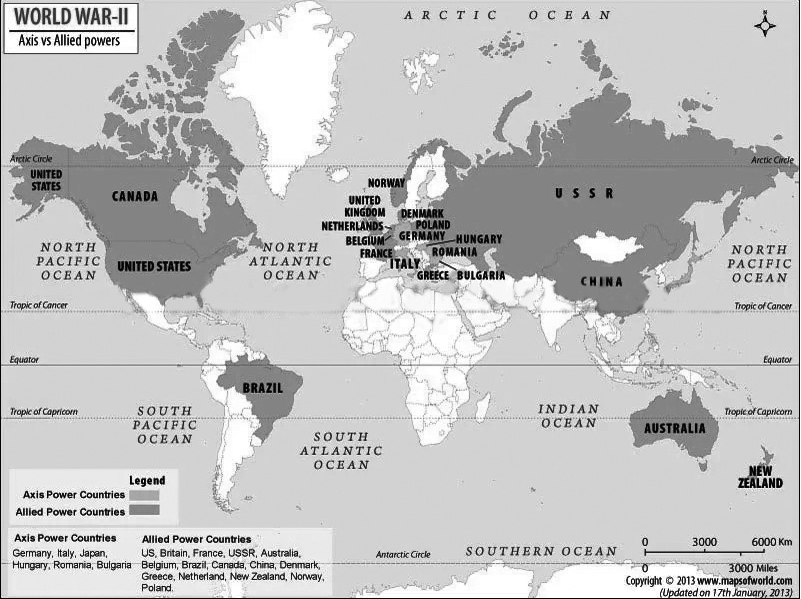
On September 27, 1940, Germany, Italy, and Japan signed the Tripartite Pact in Berlin, pledging mutual support to one another in the event of an attack.
The three Axis powers also agreed to recognize Germany and Italy as the leaders in establishing a new order in Europe, while Japan would hold similar leadership in Asia. Additionally, countries like Hungary, Romania, and Bulgaria joined the pact.
The war expanded to other regions of Europe and Africa. Italy invaded Greece but encountered strong resistance. Nonetheless, German forces eventually captured Greece, Yugoslavia, and parts of North Africa. Italian and British troops engaged in battles over various territories in Africa, a conflict that would continue for another two years.
Germany turns against Soviet Union
A new phase of the war began when Hitler decided to invade the Soviet Union. The Non-Aggression Pact was abandoned, and Operation Barbarossa was launched on June 22, 1941, without any formal declaration of war.
The German army quickly advanced on three fronts— Leningrad, Moscow, and Kiev—taking the Soviet forces by surprise and forcing them to retreat. In response to the Soviet appeal for assistance, Britain and the USA provided support.
Hitler had hoped to conclude the campaign before winter set in. By early October, Moscow was surrounded, but the harsh Russian winter soon arrived. Neither German soldiers nor their equipment were prepared to withstand the extreme cold.
In December, the Soviet counter-offensive began, pushing the German forces back and ending the immediate threat to Moscow. Though Operation Barbarossa failed, the Germans would only accept total defeat after enduring another brutal winter and facing the determined resistance of the Soviet Red Army.
A Global War
Since the outbreak of war, the United States had been supportive of Britain, allowing it to purchase arms initially on a ‘Cash and Carry’ basis, and later through the ‘Lend-Lease’ program. In November 1941, this support was extended to the Soviet Union as well. However, the
U.S. remained opposed to directly entering the conflict.
That changed on December 7, 1941, when Japan launched a surprise attack on the American naval base at Pearl Harbor in Hawaii. The assault destroyed much of the American Pacific Fleet and resulted in the deaths of over 2,000 soldiers. The following day, December 8, the U.S. declared war on Japan, and shortly thereafter on Germany and Italy, turning the conflict into a truly global war.
After Pearl Harbor, Japanese forces advanced rapidly across the Far East, capturing Thailand, Malaya, Singapore, Hong Kong, the Philippines, and Burma by mid-1942. This marked the height of the fascist powers’ expansion.
The Battle of Stalingrad
During the summer of 1942, Hitler’s forces continued their offensive in the Soviet Union, once again hoping for a decisive victory. However, their advance was halted at Stalingrad.
By November, German troops had surrounded Stalingrad, but Soviet forces managed to encircle them in turn, cutting off all supplies to the German army.
The harsh Russian winter took a heavy toll, and by January 31, 1943, the German army had collapsed. Germany and its allies suffered nearly 250,000 casualties in the battle, which became a major turning point in the war. The Soviet Union also endured severe losses in both dead and wounded.